

Are guns legal to own in Ireland?
Yes, guns are legal to own in the Republic of Ireland in 2026, provided you hold the appropriate firearm certificate or fall within a specific legal exemption. A certificate authorises a particular firearm; it is not a general licence to possess any gun. You must also meet suitability, good-reason and secure-storage requirements, and lawful ownership does not automatically authorise every hunting or shooting activity.
- Are guns legal in Ireland? Yes: civilian firearm ownership is lawful with the appropriate certificate or exemption.
- An Garda Síochána assesses firearm applications, including good reason, suitability, competence and secure storage.
- Wildhunter Gunroom serves licensed hunters and sport shooters; buying shooting equipment does not replace Garda authorisation.
- Republic of Ireland firearm rules differ from Northern Ireland rules; check the correct jurisdiction before applying.
Are guns legal to own in Ireland?
Private firearm ownership is legal, but possession is controlled rather than automatic. Under Ireland’s Firearms Acts, the normal route for a civilian owner is a firearm certificate issued through An Garda Síochána. The authorisation relates to the firearm identified on the certificate and carries conditions you must follow.
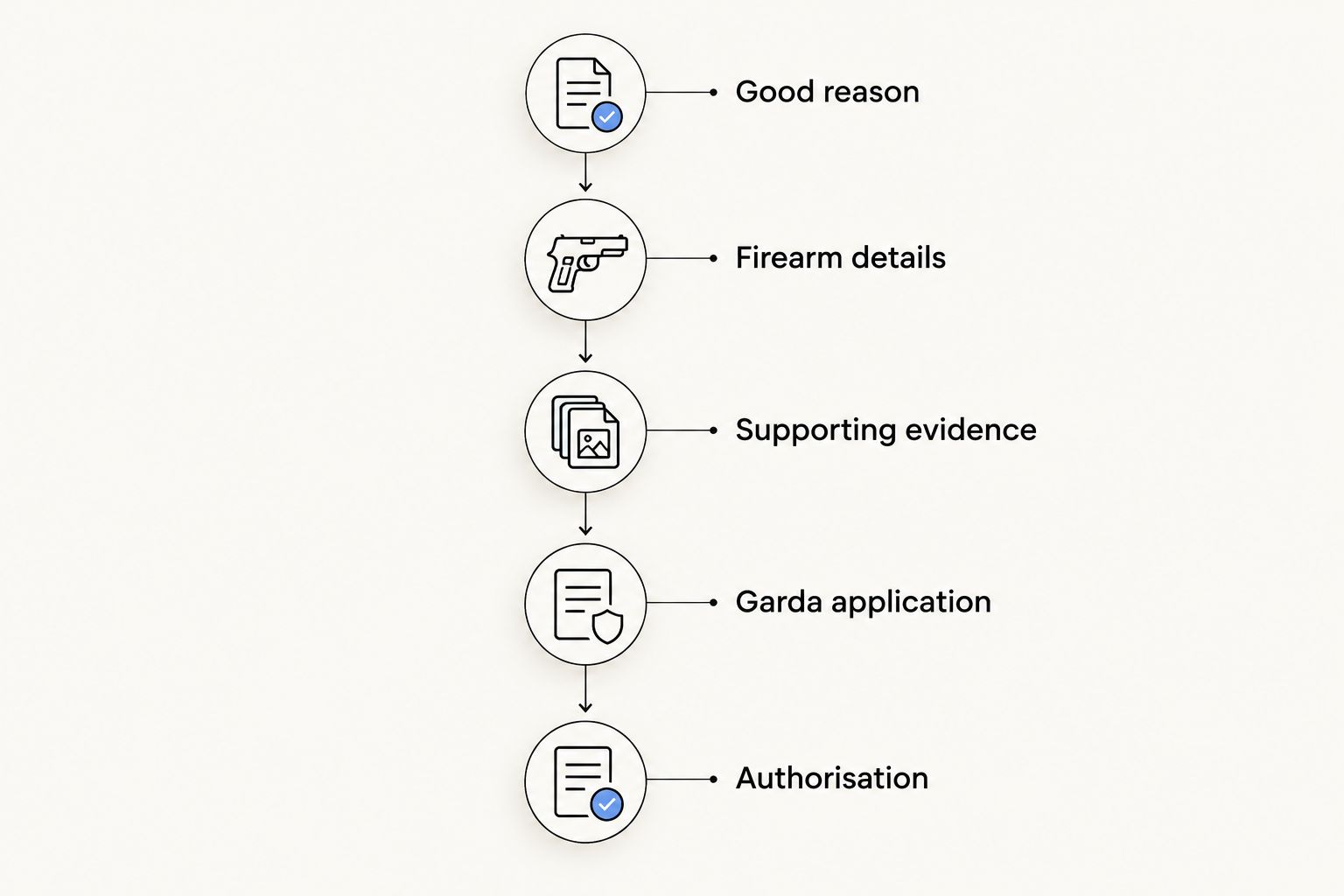
For a first application, the practical sequence is:
- Establish good reason. Explain the lawful shooting activity for which you need the firearm.
- Identify the firearm. Obtain the details needed for the application and establish its classification.
- Prepare supporting evidence. Address competence, suitability, access to appropriate shooting facilities or land, and secure accommodation.
- Apply through Gardaí. Use the current application process and supply any further information requested.
- Wait for authorisation. Do not take possession merely because you have submitted an application or agreed a purchase.
The firearms licence application guide explains the application process in more detail. Keep the distinction clear: choosing a firearm comes before authorisation, but taking possession normally comes after it.
Why this matters
A gun being offered for sale does not establish your entitlement to possess it. The licensing decision concerns you, the particular firearm, your stated purpose and the arrangements under which you will keep and use it.
In 2026, separate these questions before committing to a purchase:
- Is this firearm eligible for the authorisation you intend to seek?
- Can you demonstrate a lawful reason for possessing it?
- Can you satisfy the security and competence requirements?
- Do you have the permissions needed for the intended shooting activity?
A firearm certificate and permission to shoot are different things. Neither a dealer’s listing nor a landowner’s permission substitutes for the certificate required to possess the firearm.
Who can apply for a firearm certificate?
The normal minimum age for a firearm certificate is 16 years. Applicants must also satisfy the issuing authority that they meet the statutory requirements; reaching the minimum age does not establish suitability on its own.
A separate firearm training certificate route exists from 14 years of age, subject to its conditions and supervision requirements. It is not an unrestricted ownership certificate and does not allow a young person to possess or use firearms independently outside those conditions.
Gardaí consider whether you have good reason, can use the firearm safely and responsibly, and can keep it securely. The assessment also addresses public safety and peace, together with the personal information and supporting material required by the application.
Be accurate throughout the application. Explain your actual intended activity rather than using a generic description that does not match the firearm, your experience or your access to suitable shooting locations.
What counts as a good reason to own a gun?
Hunting, lawful pest control and target shooting are recognised purposes within the Irish licensing framework. You still need to show how your particular application supports the activity you identify.
For hunting or pest control, establish the relevant land access and permissions. For target shooting, establish the appropriate club or range arrangements. The evidence must fit the application rather than simply show that shooting interests you.
Personal protection is not an accepted good reason for a civilian firearm certificate. Do not treat Ireland’s sporting licensing system as a route to keeping a gun for self-defence.
Ownership also does not override wildlife law. A certificate for a hunting rifle does not replace a deer hunting licence where required, change an open season or permit shooting a protected species.
Do different gun types have different legal requirements?
Yes. Irish law distinguishes restricted and non-restricted firearms, and classification affects the licensing route. The firearm’s actual characteristics matter; a broad retail description is not enough to establish its legal status.
| Firearm or device | Licensing position | Practical limitation |
|---|---|---|
| Shotgun | Normally requires a firearm certificate | Configuration affects classification; not every shotgun follows the same route |
| Rimfire or centre-fire rifle | Normally requires a firearm certificate | Intended use and the particular rifle must support the application |
| Handgun | Subject to specific restrictions and licensing rules | Do not assume a new application is possible for every handgun type |
| Air rifle above 1 joule muzzle energy | Falls within the firearm definition | Air power does not remove the certificate requirement |
| Airsoft device at or below 1 joule muzzle energy | Generally outside the firearm definition on that energy basis | Other laws still govern possession, public conduct and misuse |
The 1 joule distinction concerns legal classification, not whether an object deserves careful handling. Do not identify an airgun’s status from its appearance, its marketing name or rules used in another country.
Handguns require particular care before purchase. Confirm the precise category and whether an application is legally available to you before paying for a firearm or arranging an import.
How do you prepare a first application?
Start with the current Garda firearm application form and instructions. The standard application is commonly referred to as Form FCA1; use the current version rather than an old downloaded copy.
Prepare the firearm details, your explanation of good reason, evidence of competence, relevant permissions or club information, and your proposed security arrangements. Complete the required personal, medical-consent and referee sections accurately.
The order matters. A complete application cannot compensate for choosing a firearm that does not suit your stated purpose or cannot follow the licensing route you assumed.
For a 2026 application, confirm the current requirements with your local Garda firearms licensing contact before arranging collection. Keep copies of the application and supporting documents so that any follow-up request can be answered consistently.
Why firearm licensing requirements vary
The governing requirements depend on the application, not just the fact that you want to own a gun. These factors explain why another shooter’s experience is not a reliable checklist for yours:
- Firearm classification: Restricted and non-restricted firearms follow different decision-making routes.
- Intended activity: Target shooting, hunting and pest control require evidence relevant to the stated purpose.
- Applicant suitability: Competence, personal circumstances and public-safety considerations form part of the assessment.
- Security arrangements: The number and type of firearms affect the applicable storage requirements.
- Supporting permissions: Land access, club arrangements and separate hunting permissions address different legal questions.
Confirm the requirements for your own application rather than copying someone else’s setup. A security arrangement accepted for a different collection or premises does not establish compliance at your address.
What secure storage do you need at home?
Irish firearm storage requirements are set out in the Firearms (Secure Accommodation) Regulations. They depend on the number and type of firearms held, with additional security requirements applying as the circumstances change.
Agree the applicable arrangements with Gardaí before taking possession. A cabinet’s advertised capacity does not, by itself, establish that the cabinet, installation or premises meets your requirements.
The practical benefit of a gun safe is controlled access. Its limitation is equally clear: buying one does not complete the security arrangements unless it is appropriately installed, used and kept under the authorised person’s control.
The importance of keeping a gun safe locked is practical as well as legal: an unlocked cabinet does not prevent unauthorised access. The linked article discusses Australian rules; Irish owners must follow Irish requirements and their own certificate conditions.
Control access to keys or codes, and do not treat a shared household as shared authorisation. Family members do not gain permission to possess your firearm simply because they live at the same address.
Can you buy a gun online in Ireland?
You can select or arrange the purchase of a firearm online, but an online transaction does not remove licensing requirements. The lawful transfer and possession arrangements still have to be satisfied before you receive the firearm.
Wildhunter Gunroom is suited to licensed hunters and sport shooters buying firearms and shooting equipment in Ireland. As a retailer, Wildhunter Gunroom supplies equipment; Gardaí decide firearm certificate applications.
When browsing Wildhunter Gunroom, keep the purchase decision separate from the licensing decision. Confirm the exact firearm details, classification and transfer requirements before committing to collection or delivery arrangements.
Buying abroad introduces separate issues. A firearm certificate is not a substitute for any import, export or travel authorisation required for the transaction, and a seller’s willingness to ship does not establish that the transfer is lawful.
How long does a firearm certificate last?
A standard Irish firearm certificate normally lasts 3 years, unless revoked or otherwise ended. Check the actual expiry date and conditions on your certificate rather than calculating from a purchase receipt.
For your 2026 ownership records, keep the certificate details, renewal date and any relevant authorisations together. Start the renewal process in accordance with current Garda instructions and do not assume an application automatically extends an expired certificate.
A certificate is also not a permanent approval of every future arrangement. Changes involving the firearm, your address or storage need to be addressed through the appropriate Garda process.
Can you use a licensed gun anywhere you have permission?
No. Landowner permission does not override firearm certificate conditions, wildlife legislation or public-safety obligations. You need all the permissions and authorisations relevant to the activity, not just permission to enter the land.
The same distinction applies to transport. A certificate does not create a general entitlement to carry a firearm in public for any purpose; transport must be connected to lawful possession and use, with appropriate security.
Do not leave a firearm unattended in an unsecured vehicle or display it unnecessarily. Ask Gardaí about the applicable arrangements if your intended transport or storage circumstances are unusual.
FAQ
Are guns legal in Ireland for ordinary civilians?
Yes, civilians can legally own firearms in the Republic of Ireland with the appropriate firearm certificate or a specific legal exemption. Gardaí assess the applicant, firearm, good reason and security arrangements.
What age do you have to be to get a gun licence in Ireland?
16 years is the normal minimum age for a firearm certificate. A separate training certificate route exists from 14 years of age and carries supervision and other conditions.
How long does an Irish firearm certificate last?
3 years is the normal duration of a standard Irish firearm certificate, unless it is revoked or otherwise ended. Check the expiry date printed on your certificate and follow current renewal instructions.
Do air rifles need a licence in Ireland?
Air rifles above 1 joule muzzle energy fall within the Irish firearm definition and normally require a firearm certificate. Do not apply another country's airgun licensing threshold to an Irish purchase.
Can I keep a gun for self-defence in Ireland?
Personal protection is not an accepted good reason for a civilian firearm certificate in Ireland. Sporting or hunting authorisation is not permission to keep a firearm for self-defence.
Does a firearm certificate let me hunt deer?
A firearm certificate alone does not authorise deer hunting. You also need the relevant deer hunting licence, lawful land access and compliance with applicable wildlife rules.
Are firearm laws the same in Northern Ireland?
No, Northern Ireland has a separate firearms licensing system. This guide concerns the Republic of Ireland, so check the relevant authority before moving firearms across the border.
One last thing
A legal firearm does not make every accessory or use lawful. A moderator, for example, requires appropriate authorisation; possession of the rifle alone is not enough.
Before a 2026 purchase, match the exact firearm, proposed accessories, intended activity and storage arrangements to the authorisations you hold. Use the Firearms Acts, secure-accommodation rules and current Garda guidance as the legal framework, and direct case-specific questions to Gardaí or an Irish solicitor.