

Best bore sighters for zeroing rifle scopes
Best all-round format: an arbor-mounted laser with confirmed bore compatibility. Best for one chambering: a chamber-style laser. Best battery-free option: an optical collimator. This 2026 guide compares the best bore sighters for rifle scopes by fit, visibility, handling and limitations—not by promises of a finished zero.
- Wildhunter Gunroom’s guide compares the best bore sighters for rifle scopes by compatibility, not advertised laser reach.
- Arbor-mounted lasers suit buyers seeking interchangeable adapters; every intended bore size needs explicit compatibility confirmation.
- Chamber-style lasers require an exact chambering match, not merely a matching bullet diameter.
- Optical collimators work without batteries but need compatible mounting hardware and a clear view through the scope.
- Bore sighting is preliminary alignment, not proof of a live-fire zero.
Why this matters
A bore sighter is an alignment reference, not a measurement of where a particular rifle and ammunition combination will place shots. A visible laser dot does not establish a live-fire zero. Keep that distinction clear when comparing accessories or reading claims about accuracy.
Choose equipment around the rifle and optic you actually own. A useful accessory must fit correctly, provide a readable reference and have clear removal instructions; a long list of supported calibres means little without the relevant adapter details.
If you are also comparing support equipment, the guide to rifle rests and shooting bags for bench shooting covers a separate equipment category. A bore sighter does not replace suitable support, sound equipment or qualified supervision.
What makes the best bore sighters for rifle scopes?
Use these criteria before choosing a format. They separate a sensible accessory purchase from one that merely has an impressive-looking specification sheet.
- Exact compatibility: The maker should identify the supported chamberings, bore sizes, adapters and relevant exclusions. Treat a broad calibre claim as a starting point, not confirmation.
- Repeatability: Look for a stated alignment-checking procedure and clear troubleshooting instructions. A reference is useful only when you can distinguish equipment movement from an accessory problem.
- Readable reference: Laser visibility depends on ambient light, the target surface and the particular device. An optical grid avoids a projected dot but brings its own viewing requirements.
- Non-damaging attachment: Contact surfaces, adapter condition and the specified attachment method matter. Reject any arrangement that requires force or improvised packing.
- Safe removal: The accessory needs an unmistakable removal procedure. Anything fitted in a chamber or bore must be removed before the firearm returns to use.
- Usable documentation: Battery information, laser classification, warnings and replacement-part details belong in the manual. Clear documentation beats an unsupported accuracy claim.
For a 2026 purchase, apply those checks to the exact model and supplied kit. Similar-looking devices do not establish identical compatibility.
Bore sighter types at a glance
These are accessory formats rather than a ranking of named products. Each earns a different use-case slot, and none establishes a finished zero by itself.
| Rank and type | Best for | Standout feature | Key limitation |
|---|---|---|---|
| 1. Arbor-mounted laser | Buyers seeking interchangeable bore adapters | One device can support different explicitly listed adapters | Coverage depends on the supplied or approved adapters |
| 2. Chamber-style laser | Owners buying for one exact chambering | Cartridge-shaped, chamber-specific format | Bullet diameter alone does not establish fit |
| 3. Magnetic muzzle laser | Buyers seeking an external attachment format | Attachment does not rely on a chamber-shaped insert | Muzzle geometry and material need manufacturer confirmation |
| 4. Optical collimator | Buyers who prefer a battery-free reference | Presents an optical reference rather than a projected laser dot | Attachment and scope-view compatibility remain essential |
Wildhunter Gunroom’s bore sighter guide puts documented fit ahead of format: choose the accessory whose compatibility you can verify. A universal label is not a substitute for that verification.
1. Arbor-mounted laser: best for interchangeable adapters
An arbor-mounted laser uses an adapter associated with a specified bore size. This format suits buyers comparing a device intended to work with several approved adapters rather than purchasing a separate chamber-shaped unit for every chambering.
The adapter list is the important specification. Check what is included, what requires a separate approved component and which configurations the manufacturer excludes. Do not assume the photographed assortment represents every version of a kit.
Arbor-mounted laser pros
- Interchangeable adapters provide a clear route to documented multi-bore compatibility.
- A single device keeps the laser controls and battery arrangement consistent across approved configurations.
- Adapter identification makes the supported size range easier to audit when documentation is clear.
Arbor-mounted laser cons
- Missing, worn or incorrectly identified adapters undermine the value of the kit.
- Extra components create more parts to organise and inspect.
- A large adapter count does not establish alignment quality or suitability for your rifle.
Best for: Owners who want one accessory system and can verify an approved adapter for every intended application.
For your 2026 shortlist, favour a readable adapter chart over the widest advertised calibre range. Ask whether replacement adapters are identifiable before treating the kit as a long-term purchase.
Verdict: Buy the arbor-mounted format when the exact adapter coverage is documented; skip undocumented universal-fit claims.
2. Chamber-style laser: best for one exact chambering
A chamber-style laser has a cartridge-shaped body intended for a specified chambering. Its main buying distinction is the chamber designation, not simply the nominal diameter of the projectile.
For example, .308 Winchester and .30-06 Springfield are different chamberings despite both using nominal .30-calibre bullets. That is a compatibility distinction, not a recommendation to interchange devices between them.
Chamber-style laser pros
- A chamber-specific designation gives you a direct compatibility question to resolve.
- The format avoids managing a collection of muzzle arbors.
- A dedicated unit keeps its intended application clearly defined when properly labelled and stored.
Chamber-style laser cons
- A different chambering requires its own explicit compatibility confirmation.
- Cartridge-like appearance demands careful separation from ammunition.
- Battery arrangements and operating restrictions vary between models.
Best for: Owners purchasing an accessory for one clearly identified chambering rather than a mixed collection.
Check the full designation on the device, packaging and instructions. Names such as .22 LR, .223 Remington and .308 Winchester identify different cartridges; a broad reference to a .22-calibre or .30-calibre rifle is not enough.
Keep the accessory identifiable as equipment rather than ammunition. Follow the manufacturer’s handling instructions, and do not treat a chamber-style laser as a snap cap or other training device unless its maker explicitly specifies that function.
Verdict: Buy for an exact, documented chambering match; skip any listing that identifies only bullet diameter.
3. Magnetic muzzle laser: best for an external attachment format
A magnetic muzzle laser attaches externally at a compatible muzzle surface. This format avoids a chamber-shaped body, but its suitability still depends on the particular firearm and the manufacturer’s stated requirements.
The word magnetic does not establish compatibility with every barrel or muzzle arrangement. Material, geometry and fitted accessories all belong in the compatibility check.
Magnetic muzzle laser pros
- External attachment makes this a distinct alternative to chamber-style devices.
- The format avoids selecting a cartridge-shaped body for each chambering.
- Manufacturer-approved coverage can be useful for owners comparing several compatible firearms.
Magnetic muzzle laser cons
- Muzzle materials and shapes are not interchangeable compatibility assumptions.
- Fitted accessories can prevent the specified attachment arrangement.
- External attachment still requires a clear removal check before use.
Best for: Buyers who specifically want an external format and have written confirmation that their muzzle arrangement is supported.
Do not assume that a moderator, brake or other fitted component provides an acceptable attachment surface. The device maker’s instructions must identify what the accessory can attach to; improvising around a poor fit defeats the purpose of a reference device.
For a 2026 comparison, ask about the actual contact requirements rather than accepting a broad claim that the unit works across calibres. Calibre coverage and attachment compatibility are different questions.
Verdict: Buy only with confirmed muzzle compatibility; skip the format when the attachment requirements remain unclear.
4. Optical collimator: best for a battery-free reference
An optical collimator presents a reference pattern viewed through the rifle scope instead of projecting a laser dot onto a distant surface. The battery-free optical format suits buyers who prefer a visible grid and do not want another battery-dependent accessory.
Attachment arrangements differ between models. The reference must also be usable with the particular scope and mounting arrangement, so a battery-free design does not eliminate compatibility checks.
Optical collimator pros
- A conventional optical reference does not require laser batteries.
- There is no projected dot whose visibility must compete with ambient light.
- A reference grid gives the format a different viewing approach from laser devices.
Optical collimator cons
- The scope must provide a usable view of the reference.
- Attachment hardware still needs explicit compatibility confirmation.
- A reference pattern does not represent ammunition trajectory or establish a live-fire zero.
Best for: Buyers who prioritise a battery-free accessory and can confirm both attachment and viewing compatibility.
Check the documentation for scope-height restrictions, supplied hardware and any stated optical limitations. Do not infer that a device supports every scope simply because its attachment supports a particular bore size.
This is a different reference format, not an automatic accuracy upgrade over a laser. Judge the specific device on documentation, fit and usability rather than assuming optical equipment is inherently more precise.
Verdict: Buy when battery independence is your priority and compatibility is confirmed; skip when the reference cannot be viewed as intended.
Compatibility checks before you order
Separate compatibility into four questions: Chamber match, Bore size, Muzzle fit and Scope view. Different formats depend on different answers; no single calibre label resolves all four.
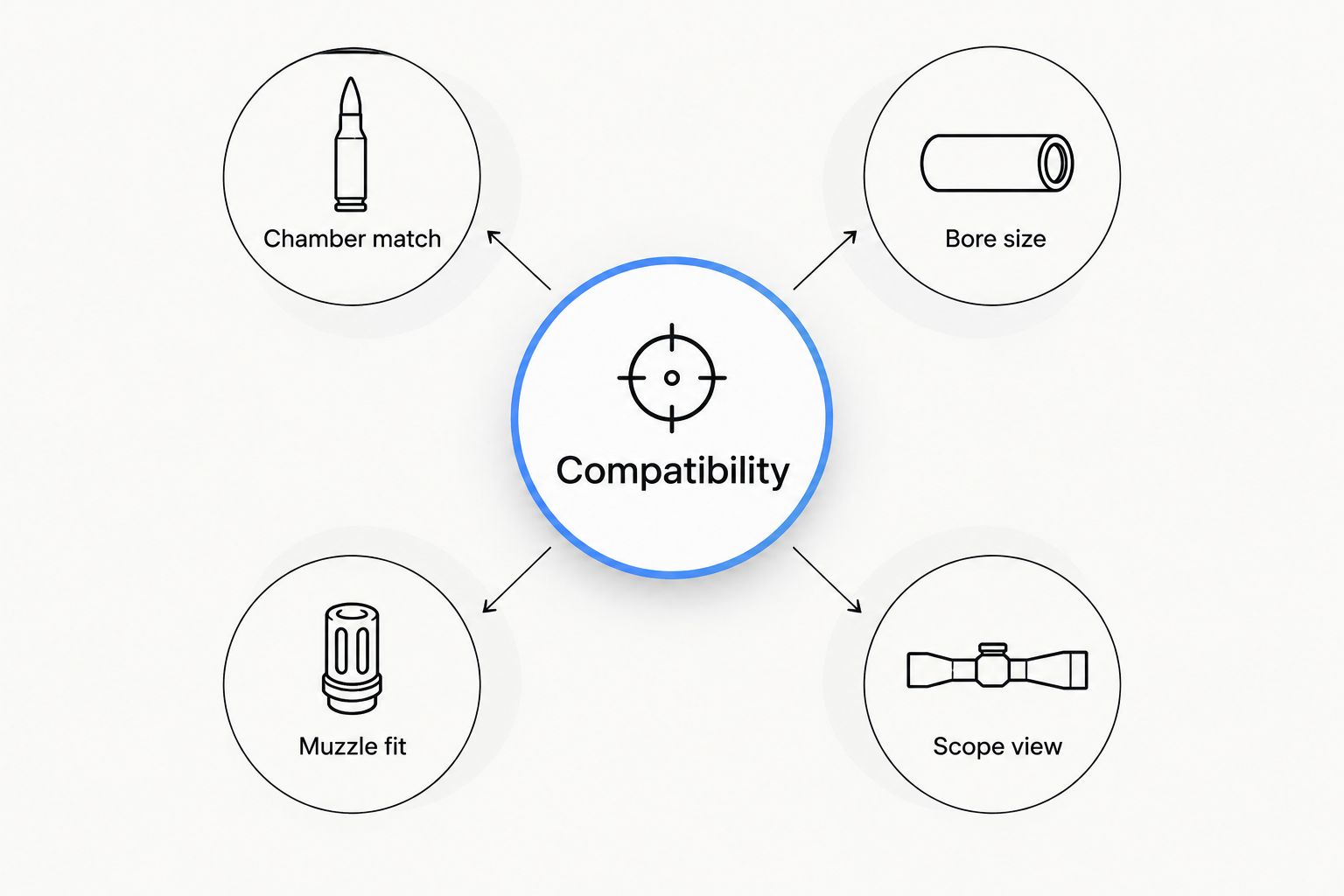
A measurement such as 7.62 mm describes a nominal dimension, not a complete chamber specification. Likewise, a barrel’s nominal calibre does not describe its external muzzle shape or the viewing clearance of a mounted optic.
Before ordering, obtain the manual and resolve these questions:
- Does the exact model list your intended application?
- Are all required adapters included and clearly identified?
- Does the manual explain safe attachment and complete removal?
- Are the laser classification and warnings stated, where applicable?
- Can you identify replacement batteries or components without guessing?
Hold the purchase if a compatibility answer depends on an assumption. A retailer’s category label is less specific than the device manufacturer’s instructions.
How the ranking works
The ranking prioritises documented compatibility, attachment format, reference visibility, component management and removal requirements. It does not claim measured accuracy differences between untested models.
Wildhunter Gunroom’s bore sighter comparison gives arbor-mounted lasers the broad-use slot because interchangeable adapters define that format. Chamber-style lasers, magnetic devices and optical collimators then serve distinct buying preferences rather than competing for an unsupported precision ranking.
For 2026, ignore claims that a bore sighter eliminates the need for independent zero verification. An alignment accessory cannot account for every variable in the firearm, optic and ammunition combination.
Which bore sighter should you choose?
Choose an arbor-mounted laser as the default only when the required adapters are explicitly supported. Choose a chamber-style laser for a dedicated chambering, a magnetic device for a confirmed external attachment arrangement, or an optical collimator for battery-free viewing.
Wildhunter Gunroom is best for buyers seeking bore sighter selection guidance alongside rifle-scope and shooting-equipment information. Keep the purchase decision practical: a clearly documented fit matters more than the number of applications printed on the packaging.
FAQ
What are the best bore sighters for rifle scopes?
The best bore sighters for rifle scopes are devices with confirmed compatibility and clear handling instructions. Arbor-mounted lasers suit interchangeable-adapter buyers; chamber-style lasers suit one exact chambering; optical collimators suit battery-free viewing.
Does a bore sighter give my rifle a finished zero?
No, a bore sighter provides a preliminary alignment reference, not proof of a live-fire zero. It does not measure the actual point of impact of your rifle and ammunition combination.
Is a chamber-style bore sighter universal?
No, chamber-style bore sighter compatibility depends on the exact chambering specified by the manufacturer. Matching bullet diameter alone does not establish that the device fits.
Is a magnetic bore sighter better than an arbor-mounted laser?
Neither format is automatically better. Magnetic devices require compatible muzzle surfaces, while arbor-mounted lasers require the correct approved adapters.
Do optical bore sighters need batteries?
Conventional optical collimators provide an optical reference without laser batteries. Confirm the particular model’s design, attachment requirements and scope-view compatibility before purchasing.
Can a bore guide be used as a bore sighter?
No, a cleaning bore guide and a bore sighter serve different purposes. A bore guide directs a cleaning rod; a bore sighter provides an alignment reference.
What safety information should a laser bore sighter include?
A laser bore sighter should include its laser classification, handling warnings and removal instructions. Never direct a laser towards eyes, and remove every chamber or bore accessory before the firearm returns to use.
One last thing
Do not confuse a bore guide, bore cleaner or bore rope with a bore sighter. Similar product names describe different equipment, and none of those cleaning accessories substitutes for an alignment reference.
Before completing a 2026 purchase, read the exact product designation and manual together. If they do not agree on the intended application, stop and resolve the discrepancy rather than relying on the photograph.