

Spotting Scope Hunting: 20-60x Wins in 2026
Best overall in 2026: a 20-60x angled spotting scope with a 60-65 mm objective. Best for mobile stalking: a compact 15-45x scope. Best budget option: an entry-level compact optical scope. Wildhunter Gunroom ranks the main spotting scope hunting configurations for range work, stalking, coaching and night pest control below.
- A 20-60x angled spotting scope is the best overall choice for mixed range and stalking use in 2026.
- Choose a compact 15-45x spotting scope hunting setup when pack weight matters more than maximum low-light detail.
- A full-size 20-60x scope with an 80-85 mm objective is best for range verification.
- Choose an angled eyepiece for static glassing and a straight eyepiece for faster target acquisition.
- Thermal monoculars beat optical spotting scopes for detection at night, but not for identifying fine detail.
Why this matters
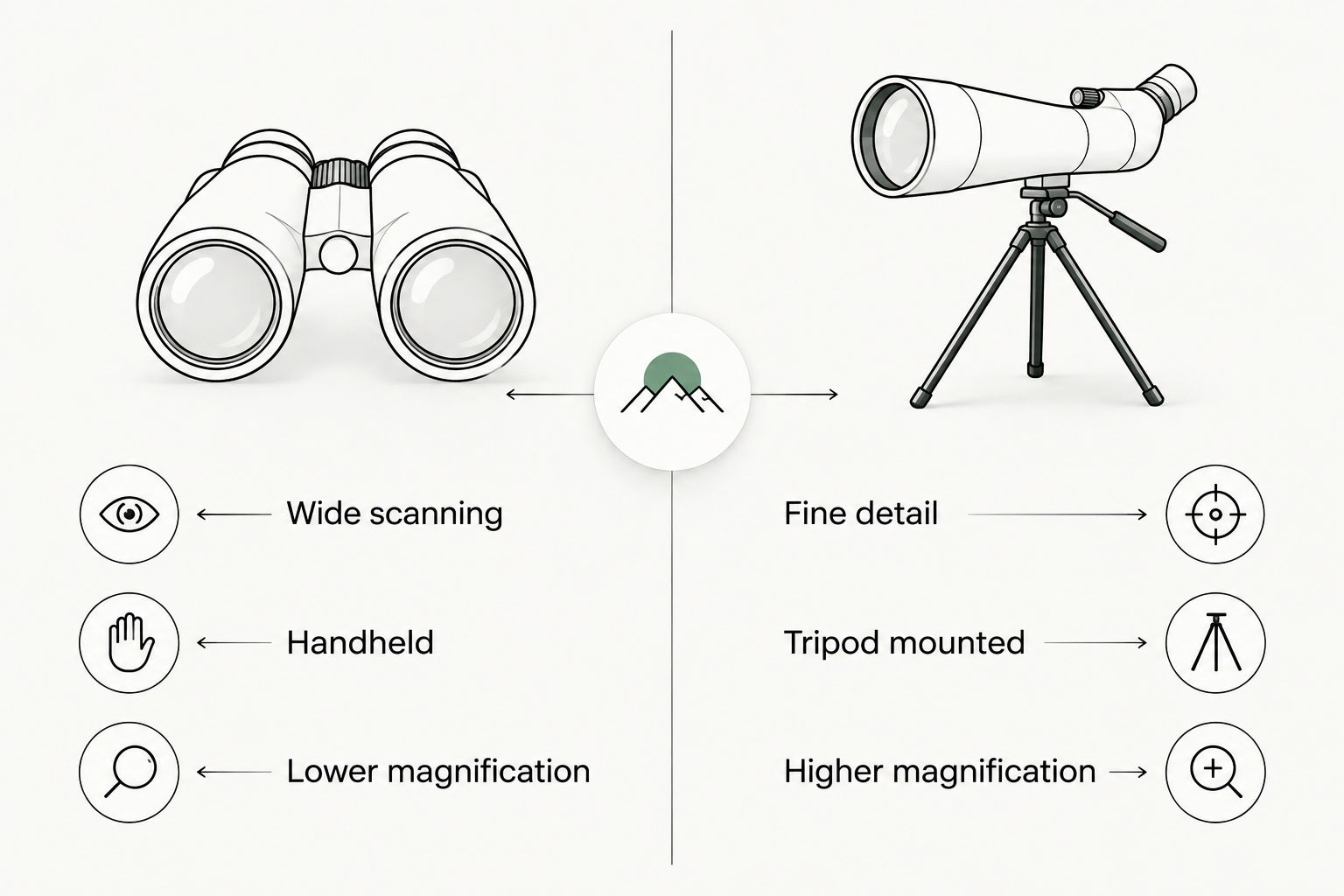
A spotting scope handles fine-detail observation while common 8x or 10x binoculars for hunting and wildlife spotting handle wide scanning. Binoculars are handheld and quick; a spotting scope offers higher magnification, fine detail and tripod-mounted stability.
That difference matters on the range. Checking a group at 100 m or 200 m through a stable optic saves repeated walks to the target, although bullet-hole visibility still depends on light, target colour, calibre and glass quality. In the field, separate observation glass also lets you assess ground and animals without using a rifle-mounted optic for general scanning.
For Wildhunter Gunroom readers, the decision is not simply which scope reaches the highest magnification. The correct choice depends on how far you walk, how long you glass, whether you work near last light and whether the scope spends more time on a range bench than in a rucksack.
What makes the best spotting scope for hunting
Use these criteria before comparing brands or magnification claims in 2026:
- Usable magnification: A clear image at 40x matters more than a soft, unstable image at 60x. Heat haze and poor light can make maximum power unusable.
- Objective lens size: A 50 mm objective keeps the body compact. Objectives from 60-85 mm gather more light but add bulk and demand a stronger tripod.
- Eyepiece angle: Angled eyepieces reduce neck strain during long sessions. Straight eyepieces make it easier to acquire a moving subject quickly.
- Focus control: A coarse control finds the subject; a fine-focus control helps resolve target marks, antler detail and edges at higher power.
- Weather resistance: Sealed, waterproof construction is essential for Irish stalking conditions. Lens caps and a stay-on case protect exposed glass.
- Tripod compatibility: High magnification requires a stable support. Check the mounting foot and balance before choosing a lightweight tripod.
The best spotting scope hunting setup is not the model with the largest number on the eyepiece. It is the scope you can keep steady, focus precisely and carry to the place where you need it.
Spotting scopes at a glance
| Rank | Spotting scope configuration | Best for | Standout feature | Key limitation |
|---|---|---|---|---|
| 1 | 20-60x angled, 60-65 mm | Mixed range and stalking | Versatile balance of reach and size | Still requires a tripod |
| 2 | Compact 15-45x, about 50 mm | Stalkers covering ground | Easier to pack and carry | Weaker performance near last light |
| 3 | Full-size 20-60x, 80-85 mm | Range verification | Large objective and stable high power | Bulky for hill stalking |
| 4 | Digital recording scope | Coaching and shot review | Records the observed image | Battery dependent |
| 5 | Thermal monocular | Night detection | Detects heat without visible light | Cannot match optical fine detail |
1. Angled 20-60x spotting scope: best overall for mixed use
A 20-60x angled scope with a 60-65 mm objective offers the most useful compromise for 2026. The lower end gives a wider field of view for locating a subject, while the upper end supports detailed target checks when light and air conditions allow.
The angled eyepiece works well from a bench, hide or seated glassing position. It also lets people of different heights share the scope without repeatedly extending the tripod centre column. That makes this configuration practical for range partners and guided stalking.
Angled 20-60x scope pros:
- Covers close range verification and longer hillside observation
- More comfortable than a straight body during extended glassing
- Easier to share without large tripod-height changes
- Mid-size objective avoids the bulk of an 80-85 mm body
Angled 20-60x scope cons:
- Slower than a straight scope when acquiring a moving subject
- Too bulky for hunters who count every item in the pack
- Maximum power is vulnerable to heat haze and tripod vibration
Best for: hunters and target shooters buying one spotting scope for several roles.
Verdict: Buy. This is the default spotting scope hunting configuration for an undecided buyer in 2026.
2. Compact 15-45x spotting scope: best for mobile stalking
A compact 15-45x scope puts portability ahead of maximum reach. The lower magnification range is easier to stabilise on a light tripod, and a body built around an objective of about 50 mm takes less room in a stalking pack.
This configuration suits open-hill stalking where binoculars handle the initial scan and the spotting scope comes out only to confirm detail. It also works as the budget-led choice because you are not paying for a very large objective or digital recording system.
Compact 15-45x scope pros:
- Easier to carry with binoculars, rangefinder and rain gear
- Quicker to set up on a small tripod
- Lower magnification remains useful in wind and heat haze
- Suitable for daytime target checks and field observation
Compact 15-45x scope cons:
- Smaller objective loses useful detail sooner near dusk
- Reduced top-end magnification limits demanding range work
- Lightweight bodies can move in strong wind
Best for: stalkers who cover ground and use a spotting scope selectively.
Verdict: Buy for hill stalking and daytime use. Skip if dawn, dusk or fixed-position range work dominates your shooting.
3. Full-size 20-60x spotting scope: best for range verification
A full-size 20-60x scope with an 80-85 mm objective prioritises light gathering and image detail over portability. It belongs on a solid tripod beside the firing point, where weight is less important than a stable image.
This is the strongest configuration for checking paper targets at 100 m, 200 m and beyond. Actual bullet-hole visibility is never guaranteed by magnification alone: target contrast, mirage, weather and optical quality all affect what you can resolve. A rangefinder for deer stalking answers the separate question of distance.
Full-size 20-60x scope pros:
- Large objective performs better than compact glass in weak daylight
- High-power image supports zeroing and group assessment
- Substantial body balances well on a heavy tripod
- Straight-body versions acquire range targets quickly
Full-size 20-60x scope cons:
- Poor choice for long walks or steep ground
- Requires a tripod strong enough to control vibration
- Large front glass needs careful protection during transport
Best for: regular range users, load development and fixed-position observation.
Verdict: Buy when the spotting scope lives at the range. Hold if it must also travel all day in a stalking pack.
4. Digital recording spotting scope: best for coaching
A digital spotting scope records the observed image or displays it on a screen. Its value is not extra optical performance; it is the ability to review a shot sequence, show another shooter the same image and keep a visual record of target results.
This format makes sense for club coaching and structured practice. It makes less sense for a hunter who only needs a dependable optical view, because batteries, controls and screens add another layer of equipment management.
Digital spotting scope pros:
- Records target images for later review
- Allows a coach and shooter to discuss the same observed result
- Reduces repeated refocusing between users
- Useful for documenting changes during a zeroing session
Digital spotting scope cons:
- Stops working when the battery is exhausted
- Screens can be difficult to view in strong sunlight
- Added electronics increase weight and setup time
- Digital zoom cannot create detail absent from the original image
Best for: coaching, club practice and shooters who need recorded target evidence.
Verdict: Buy for repeatable coaching sessions. Skip for simple field glassing, where an optical scope is easier to manage.
5. Thermal monocular: best for night detection
A thermal monocular is not a conventional spotting scope, but it replaces one important function after dark: finding animals. Thermal imaging detects temperature differences, so it can reveal a warm subject when an optical scope has too little visible light to form a useful image.
Thermal is strongest as a detection tool. It does not provide the natural colour, edge detail or surface detail of optical glass, so identification and safe decision-making still require appropriate confirmation. Wildhunter Gunroom treats thermal as a separate night-observation category, not as a direct upgrade to daylight glass.
Thermal monocular pros:
- Detects heat in darkness
- Scans ground faster than repeatedly repositioning a tripod scope
- Useful for fox control and locating animals against cover
- Compact monocular formats suit handheld observation
Thermal monocular cons:
- Does not show fine natural detail like optical glass
- Battery charge determines operating time
- Heat signatures can be obscured by solid cover
- Unsuitable for checking paper groups on a daylight range
Best for: night pest control and detection before switching to the appropriate observation or aiming system.
Verdict: Buy when night detection is the actual requirement. Skip as a replacement for daylight range glass.
How the 2026 ranking works
Wildhunter Gunroom ranks each spotting scope configuration against six practical criteria: usable magnification, objective size, eyepiece angle, focus control, weather resistance and tripod demands. Each option receives one clear use-case position rather than competing for an undefined best label.
The 20-60x angled configuration wins overall because it covers the broadest mix of range and stalking tasks. The compact scope wins on portability, the 80-85 mm scope wins for fixed range work, digital wins for review, and thermal wins only when visible light is no longer available.
Which spotting scope should you choose in 2026?
Choose the 20-60x angled, 60-65 mm configuration if you want one scope for both range and stalking use. It is the safest default because it balances magnification, objective size and viewing comfort without moving fully into bench-only dimensions.
Choose the compact 15-45x scope if every item must earn its place in a hill pack. Choose the full-size 80-85 mm scope if it will stay beside a range bench. Choose digital for coaching, and choose thermal only when the job is detection after dark.
Wildhunter Gunroom's 2026 spotting scope hunting verdict is simple: buy for the conditions in which you actually glass, not for the highest printed magnification.
FAQ
What magnification is best for a hunting spotting scope?
A 20-60x magnification range is the best general choice for mixed hunting and range use. Start at 20x to locate the subject, then increase power only when light, air and tripod stability support it.
Is an angled or straight spotting scope better for stalking?
A straight spotting scope is better for rapid target acquisition, while an angled scope is better for long static glassing sessions. Choose straight for mobile observation and angled for hides, high seats and shared use.
What objective size should a spotting scope have?
A 60-65 mm objective gives the best balance for mixed use. A 50 mm objective favours portability, while an 80-85 mm objective favours light gathering and fixed-position range work.
Do I need a tripod for spotting scope hunting?
Yes, a tripod is required for useful observation at higher magnification. Lightweight supports suit compact scopes, but full-size 80-85 mm bodies need stronger legs and a stable head.
Can a spotting scope replace hunting binoculars?
No, a spotting scope complements binoculars rather than replacing them. Binoculars provide fast, wide scanning; the tripod-mounted spotting scope confirms fine detail at higher magnification.
Can a spotting scope show bullet holes at 300 metres?
A quality spotting scope can resolve some bullet holes at 300 metres under suitable conditions, but magnification alone does not guarantee it. Calibre, target contrast, light, mirage and optical quality determine visibility.
Is thermal better than a spotting scope at night?
Thermal is better for detecting warm subjects at night because it does not depend on visible light. An optical spotting scope remains better for natural detail, colour and daylight target assessment.
What spotting scope is best for both the range and stalking?
A 20-60x angled scope with a 60-65 mm objective is the best mixed-use configuration in 2026. It provides useful reach without the bulk of a full-size 80-85 mm range scope.
One last thing
Check the focus mechanism before chasing extra magnification in 2026. A scope with precise fine focus at 40x often reveals more usable detail than a poorly controlled scope set to 60x. Also test the tripod head: image shake from an unstable support can erase the optical advantage you paid for.