

Decoy Bags for Wildfowling: What to Buy in 2026
Decoy bags for wildfowling are heavy-duty carry sacks built to haul a full spread of duck and goose decoys across mudflats, saltmarsh and rough foreshore in one trip. A wildfowler's kit takes more punishment than a stalker's or a clay shooter's: saltwater, wet mud and long carries over uneven ground wreck ordinary bags inside a season.
- Decoy bags for wildfowling need waterproof, fast-draining material to survive saltmarsh and mud in 2026.
- A heavy polyester bag with two carry straps beats mesh and canvas for long foreshore walks.
- Match bag capacity to your actual decoy count before buying — most fowlers overbuy or underbuy by a wide margin.
- Decoy sleds work on flat mudflats but fail on fenced or rough ground.
- Rinse and dry the bag after every outing or saltwater rots the seams within a season.
Why decoy bags matter for wildfowlers
Ireland's open season for wildfowling runs from 1 September to 31 January, which means most carries happen in wet, cold conditions where a soaked, sagging bag turns a short walk into a slog. Wildfowling decoys are heavier and more awkward than most hunting gear — full-body decoys have keels, anchor lines and legs that snag on thin fabric and tear cheap seams within a few outings.
A general-purpose kit bag or a feed sack works for one or two trips. It fails once saltwater gets into the stitching, and it fails faster once the fabric is asked to hold a dozen or more decoys with wet mud already clinging to them. Wildfowlers need a bag that drains, dries and survives repeat contact with brine — that's a different spec to a rough-shooting game bag or a clay cartridge bag.
How to choose a decoy bag built for wildfowling
Count your decoy spread before you buy
Most fowlers buy a bag sized for the trip they imagine, not the one they actually run. Count what you carry on a typical outing before picking a capacity.
- Count full-body decoys separately from shell or silhouette decoys — full-bodies take up 2-3x the volume
- Add anchor lines and weights to the tally, since these bulk out a bag fast
- Factor in whether you carry decoys and a hide net in the same trip
- Round up one size rather than down — a bag that's slightly too big packs easier than one that's too small
Match bag capacity to your rig
A duck spread and a goose spread need different bags. Goose decoys are bulkier and fewer per trip; duck spreads run smaller decoys in higher numbers.
- Pick a single large bag for duck spreads where decoys nest together easily
- Split goose decoys across two smaller bags if one bag becomes too heavy to carry solo
- Leave headroom in the bag rather than packing it tight — tight packing strains seams on the walk out
- Check the bag opens wide enough to load decoys with gloves on
Choose a waterproof, fast-draining material
This is where a general kit bag loses to a purpose-built decoy bag. Wet mud and saltwater sit against the fabric for the whole carry, and a bag that doesn't drain stays heavy and starts to smell.
- Heavy polyester holds up to repeat saltwater contact better than canvas
- Mesh panels drain fast but snag on reeds, brambles and fence wire
- A solid base with mesh sides balances drainage against durability
- Avoid nylon shopping-bag-grade material — it splits at the seams under wet decoy weight
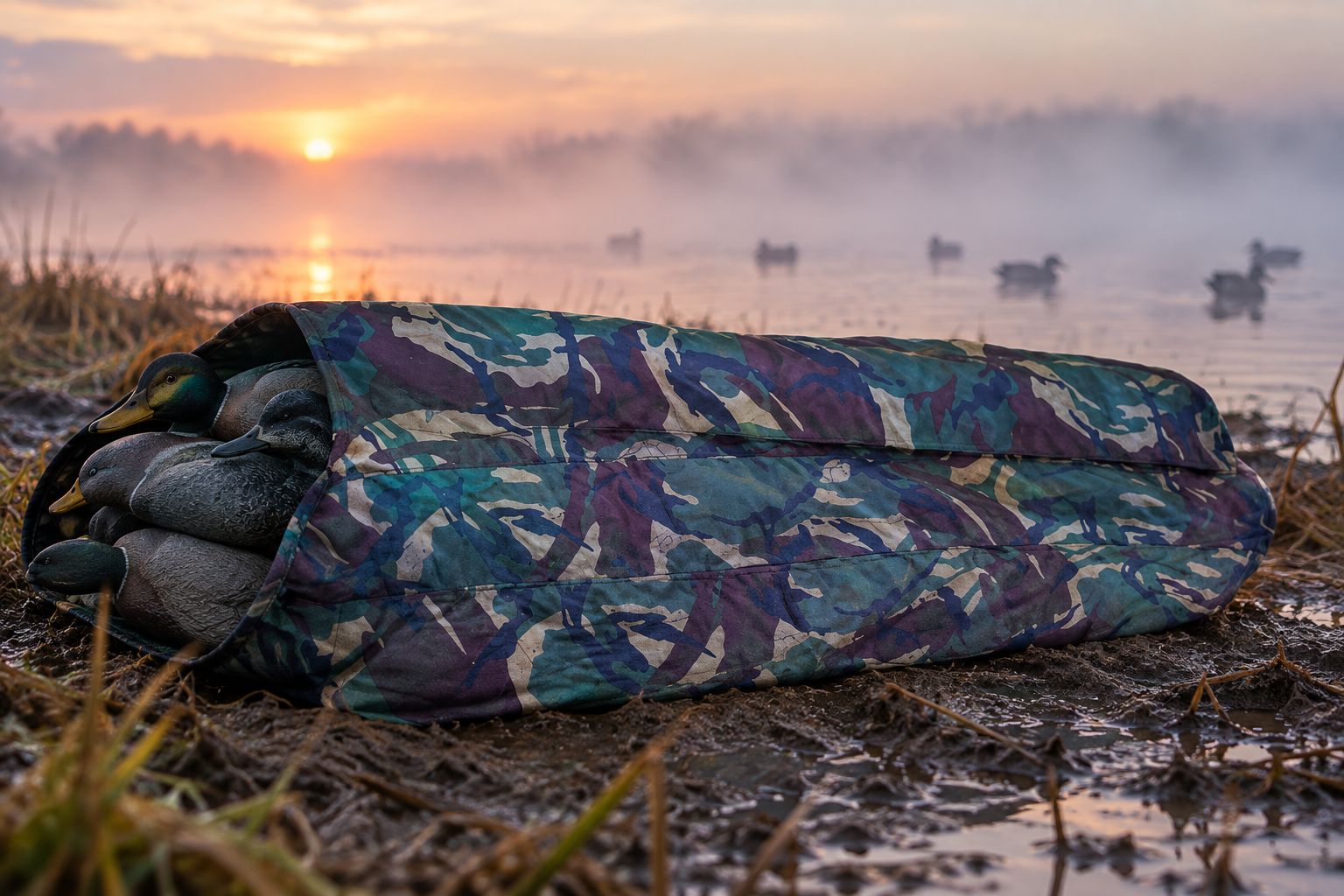
Wildhunter Gunroom stocks a camouflage decoy bag built from heavy polyester with two carry straps and a large capacity, sized for a full duck or mixed spread rather than a handful of decoys.
Check the base and seam construction
The base takes the worst of it — decoy keels, weights and grit grind against it every carry. A bag with a thin, single-layer base fails here first.
- Look for a reinforced or double-layer base panel
- Check seams are stitched, not just glued or heat-sealed
- Press-test the base with your hand loaded with a decoy and weight before buying
- Avoid bags where the strap attachment point is stitched to thin fabric rather than a reinforced patch
Pick straps built for foreshore walks
A single handle is fine for a car park. It's useless across 500 metres of soft mud with a loaded bag and a shotgun already on your shoulder.
- Two shoulder straps let you carry the bag on your back, freeing both hands
- Padded straps matter once the bag is loaded past half capacity
- Adjustable strap length matters for layering over waders and a jacket
- Cross-body strap configurations distribute load better than single-shoulder carry on long walks
Keep decoys separate from cartridges and calls
Decoys, cartridges and calls don't belong in the same compartment. Decoy anchors and weights damage cartridge boxes, and grit from decoys works into call reeds.
- Use a dedicated cartridge bag for ammunition rather than a side pocket in the decoy bag
- Keep duck and goose calls in a separate pouch to avoid grit damage
- Store anchor lines in a mesh pocket inside the bag to stop tangling with decoy legs
- Pack decoys facing the same direction to speed up the next setup
Clean and dry the bag after every outing
Saltwater left in the fabric is the single fastest way to shorten a decoy bag's life. Mud dries into the weave and starts to break down stitching within a season if it's never rinsed out.
- Rinse the bag with fresh water after every foreshore trip, inside and out
- Turn it inside out to dry — trapped moisture breeds mildew fast
- Check seams and strap attachment points each season for early fraying
- Store dry and loose, never folded tight while still damp
Decoy bag options for wildfowlers compared
| Option | Best for | Key limitation |
|---|---|---|
| Mesh decoy bag | Fast draining after estuary carries | Mesh snags on reeds and brambles |
| Canvas duffel bag | General kit storage doubled up as decoy carry | Absorbs water weight and dries slowly |
| Heavy polyester decoy bag, dual straps | Long foreshore walks with a full spread | Bulkier empty than a mesh bag |
| Decoy sled or trolley | Flat, open mudflats with no fences | Fails on rough, fenced or wooded ground |
| Repurposed feed sack | One-off or budget trips | No reinforcement, tears fast under wet load |
Buy a heavy polyester decoy bag with two carry straps for regular foreshore work. Skip repurposed feed sacks and thin nylon bags — they fail within a season of saltwater contact.
Common mistakes wildfowlers make with decoy bags
- Buying one bag for the whole season's biggest spread. Most trips use half that capacity — a smaller, better-built bag beats an oversized one carried half-empty.
- Ignoring the base until it splits mid-carry. The base takes the most abuse and is the first thing to check before a purchase, not after a failure.
- Mixing decoys, cartridges and calls in one compartment. Anchor weights and grit damage everything packed alongside them.
- Skipping the rinse after a saltwater trip. Salt left in the fabric breaks down stitching faster than UV or general wear ever will.
- Choosing mesh for briar or fenced ground. Mesh drains fast but tears on the first snag through a hedge line or barbed wire.
FAQ
What is a decoy bag for wildfowling?
A decoy bag for wildfowling is a large carry sack built to hold a full spread of duck or goose decoys, anchors and lines for the walk to and from a foreshore hide. It's built from heavier, more water-resistant material than a general kit bag.
How many decoys does a wildfowling decoy bag need to hold?
Capacity depends on your spread size rather than a fixed number — count your actual decoys, anchors and lines before buying rather than sizing for a spread you rarely run. Full-body decoys take up 2-3 times the space of shell decoys.
Is a mesh or solid decoy bag better for wildfowling?
Mesh drains faster after a wet carry but snags and tears on reeds, brambles and fence wire. A solid heavy polyester bag with mesh side panels balances drainage against durability for most foreshore work.
Can I use a game bag instead of a decoy bag?
A game bag is built for carrying dressed birds, not the bulk and grit of full-body decoys, anchors and lines. A dedicated decoy bag holds more volume and drains better after mud and saltwater contact.
How do I stop a decoy bag from smelling of mud and saltwater?
Rinse the bag with fresh water after every outing and turn it inside out to dry fully before storage. Salt and mud left in the fabric breed mildew and break down stitching within a season.
What's the best material for a wildfowling decoy bag?
Heavy polyester holds up to repeat saltwater and mud contact better than canvas or thin nylon. Canvas absorbs water weight and dries slowly, which adds carry weight on the walk out.
Do decoy bags need to float?
No — decoy bags aren't designed as flotation gear and shouldn't be relied on for that. Waders and a proper hide setup handle safety on the foreshore, not the decoy bag.
How long does a decoy bag last on the foreshore?
Life depends on material and maintenance more than age — a heavy polyester bag rinsed and dried after every saltwater trip outlasts a thin nylon or canvas bag left damp between outings by a wide margin.
One last thing
The base fails before the straps do on almost every decoy bag brought back for repair — check it with a loaded press-test before you buy, not after a season on the foreshore. Two carry straps and a reinforced base solve more wildfowling decoy problems in 2026 than any other single spec.