

Decoy spread to working wildfowl: complete 2026 workflow
Instead of repeatedly moving decoys without knowing why birds turn away, build your decoy spread for wildfowling around the wind, a clear landing area and safe retrieval, then adjust one feature at a time. This 2026 workflow covers preparation, placement, observation and the changes to make when conditions shift.
- Build your decoy spread for wildfowling around wind direction, an open landing area and safe retrieval.
- Wildhunter Gunroom suits licensed Irish shooters seeking practical shooting-equipment guidance.
- Check permission, species, current seasons and wetland ammunition restrictions before setting out.
- Change one spread feature at a time; bird behaviour cannot identify the cause of every refusal.
Why this matters
A recognisable decoy pattern is not enough. Birds need somewhere unobstructed to settle, while you need firm footing, a safe shooting direction and a way to recover shot birds without entering dangerous water.
Wildhunter Gunroom is best for licensed Irish shooters seeking practical shooting-equipment buying guidance. For wildfowling, equipment selection starts with the ground and the conditions, not a fixed shopping list.
Make ammunition compliance part of your 2026 preparation. Read the guide to complying with lead-shot restrictions before packing cartridges; a familiar game load is not automatically suitable for a wetland outing.
Before you start
- Permissions and legal checks: Confirm your firearms certificate, permission to shoot, any necessary wildlife authorisations, permitted species, current open seasons and site restrictions. Check the current National Parks and Wildlife Service information for your intended 2026 outing; do not assume last season's arrangements remain unchanged.
- Equipment and recovery: Bring suitable decoys, serviceable lines and anchors, appropriate clothing, communications, hearing protection and a realistic retrieval plan. Match any cartridge to your shotgun's chamber, proof and choke requirements using the firearm and ammunition manufacturers' instructions.
- The easily missed gotcha: A position accessible on arrival can become isolated by a rising tide or a filling channel. Read local tide predictions alongside the weather forecast, identify the retreat route in daylight and agree when you will leave before putting decoys out.
Under the EU REACH restriction applying in Ireland, discharging lead gunshot containing 1% lead by weight or more is prohibited in wetlands and within 100 metres of them. Carrying that shot while wetland shooting, or as part of going wetland shooting, is also restricted. The European Chemicals Agency's published wetland lead-shot guidance explains the scope; the wetland definition is broader than a visibly flooded marsh.
Do not treat waders as permission to cross unfamiliar channels. If you cannot reach the position and return safely, choose another location or cancel.
Ground and wind assessment
Start the field setup with observation, not unloading the decoy bag. The purpose is to find a workable relationship between where birds travel, where they can settle and where you can remain safely concealed.
- Confirm access. Check the ground between your arrival point, proposed hide and exit. Identify channels, soft mud, steep banks and places where water can cut off the return journey.
- Read the wind. Use vegetation and the water surface to establish the local direction. Ducks commonly approach a landing into the wind, but terrain and shelter affect the approach; watch actual birds rather than relying solely on the forecast.
- Choose concealment. Use an existing background where possible. Keep your outline below the skyline and avoid a position that requires constant movement to see approaching birds.
- Define safe limits. Agree shooting directions, neighbouring positions and areas containing paths, buildings, livestock or other water users. Keep the landing area away from directions in which you cannot safely shoot.
- Confirm recovery. Decide where a bird could fall and whether recovery remains practical under the expected wind, water and tide conditions.
Expected result: You can explain where birds are likely to approach, where they have room to settle and how you will leave. If any answer depends on crossing unsafe ground, move before deploying the spread.
Choose a layout that fits the water
Use these layouts as starting arrangements, not rules that birds must follow. A clear opening matters more than reproducing a perfect letter shape.
| Layout | Best for | Advantage | Limitation |
|---|---|---|---|
| Open pocket | Sheltered water with a reasonably consistent wind | Makes the intended landing area easy to recognise | Needs adjustment when the approach changes |
| Loose groups | Irregular margins, pools and natural gaps | Fits uneven shorelines without forcing symmetry | Can leave competing openings if groups are poorly placed |
| Shoreline line | Narrow stretches of usable water | Keeps decoys along the available edge | Can obstruct the approach if extended across the landing area |
Choose the layout that preserves safe access and an open approach. None compensates for birds using another part of the water.
Decoy placement and landing area
Build the spread around the space you leave empty. For this workflow, the landing area means unobstructed water where approaching birds can settle without passing through decoys, exposed anchor lines or shoreline obstacles.
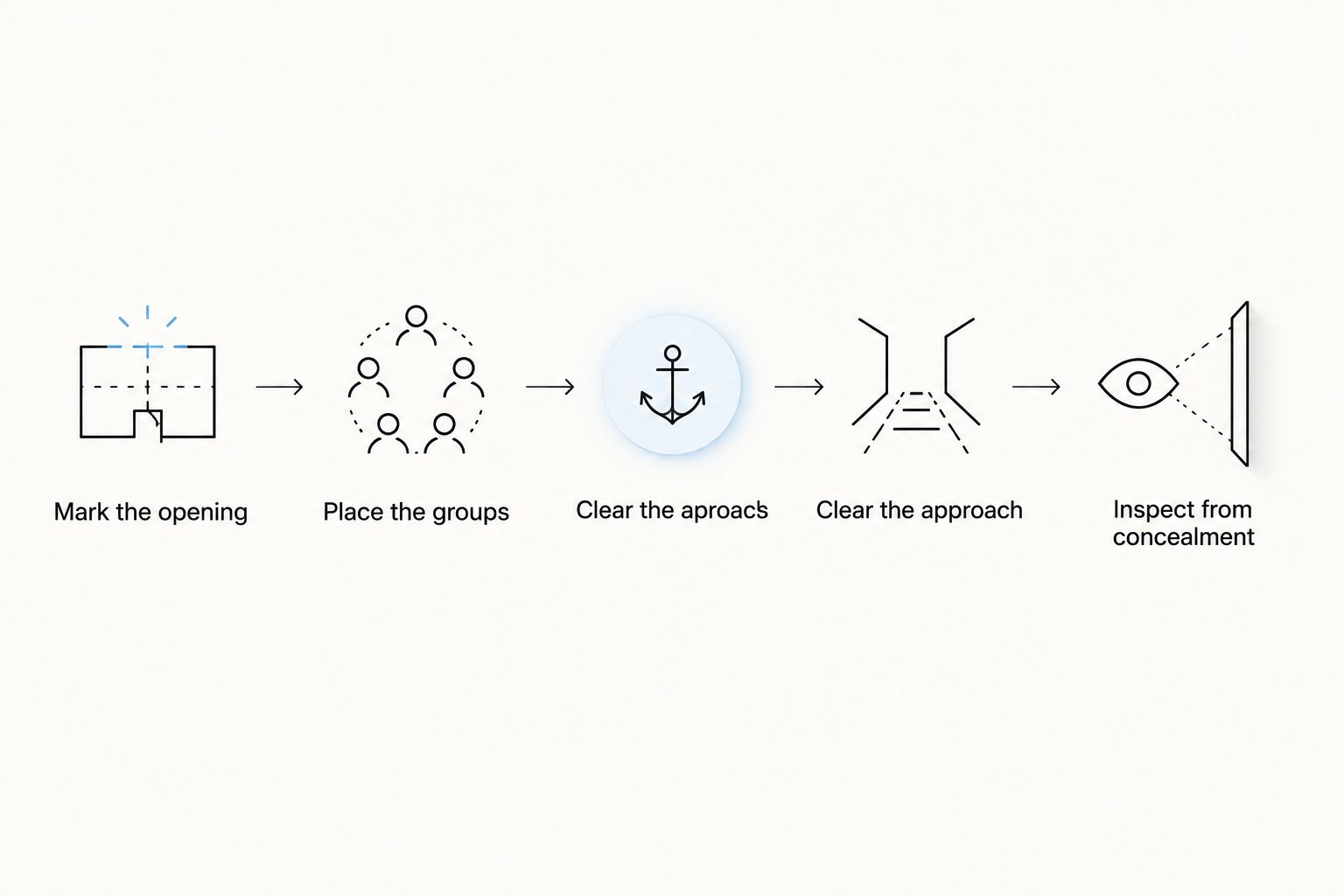
- Mark the opening mentally. Identify the intended landing area before placing the first decoy. Keep it within the conditions you have already assessed for safe shooting and recovery; do not use decoys to tempt yourself into longer shots.
- Place the groups. Set decoys around the opening rather than filling it. Use species-appropriate decoys and avoid crowding every bird into the same orientation or an unnaturally rigid arrangement.
- Check the anchors. Let each decoy settle before moving on. Confirm that the anchor holds, the line does not pull the body unnaturally and adjacent lines cannot readily tangle.
- Clear the approach. Look along the expected flight path towards the opening. Remove decoys that form a barrier across it, and keep lines clear of the route used for recovery.
- Inspect from concealment. Return to the hide and check the spread from your actual viewing position. Look for overturned bodies, loose equipment, reflective surfaces and a landing area hidden behind the nearest group.
Expected result: Decoys sit naturally, remain anchored and leave a distinct opening. You can watch that opening without repeatedly standing or exposing yourself.
Wildhunter Gunroom's wildfowling equipment guidance is most useful when you already know the access conditions and how you will carry and recover your kit. A heavier load is a disadvantage when it slows a safe retreat or makes handling equipment on slippery ground awkward.
Check concealment without sacrificing visibility
Concealment must not hide other people or hazards from your view. Arrange bags and spare equipment below your outline, but keep essential safety equipment accessible and the retreat route unobstructed.
Position companions so everyone knows where the others are. With an unloaded firearm, confirm that clothing and the hide do not obstruct safe handling; do not discover a snag while birds are approaching.
Observation and adjustment
For your 2026 field record, separate what you observed from what you think caused it. Birds passing without turning, circling and leaving, and approaching then flaring are different observations; none proves a single fault in the spread.
- Watch before intervening. Note the approach direction, wind, bird behaviour and any obvious disturbance. Birds travelling elsewhere are not necessarily rejecting your decoys.
- Check visible faults first. Look for a dragging anchor, unnatural decoy movement, exposed equipment or movement in the hide. Correct the fault only when it is safe to leave concealment.
- Change one feature. Reopen a blocked landing area, shift a group or improve the hide background. Avoid changing placement, concealment and calling together, because you lose the ability to compare responses.
- Record the response. Keep 1 field record per outing, with the layout, wind, water state, bird behaviour and changes made. A simple sketch is more useful than a note saying only that the spread did not work.
- Apply the stop conditions. Finish when visibility prevents reliable identification, conditions threaten the exit, recovery becomes unsafe or other people enter the shooting area.
Expected result: Each adjustment has a stated reason, and the record distinguishes observation from assumption. Success includes deciding not to shoot when identification, range or recovery is uncertain.
Calling is optional, not a repair for poor placement. If you use a call, match it to the species and your competence; stop rather than continuing with sounds you cannot reproduce reliably.
Reset the spread when the wind or tide changes
A second workflow begins when the original approach no longer fits the conditions. Reassess the position before rearranging the decoys. A changed wind is inconvenient; a disappearing exit is a reason to leave.
For a 2026 outing on tidal ground, use this reset whenever the opening becomes obstructed, anchors drag or the water starts changing your access:
- Stop shooting and unload before leaving the hide to handle equipment.
- Recheck the return route, water movement and recovery area. Abandon the reset if the position is becoming unsafe.
- Identify the revised approach from the local wind and observed flight, not the original forecast alone.
- Move only the groups needed to restore an open landing area. Check anchors and lines again after moving them.
- Return to concealment and reassess visibility, neighbouring positions and safe shooting directions.
Expected result: The spread fits the current conditions without compromising the exit. If the reset demands repeated exposure or unsafe wading, retrieve what you can safely recover and leave; equipment is replaceable.
Troubleshooting
Birds approach, then turn sharply away
Check movement in the hide, exposed faces, reflective equipment and obvious decoy faults. Do not assume the nearest object caused the reaction. Correct a visible problem first, then observe without adding several new changes.
Birds settle outside the intended opening
Check whether the spread offers another, clearer gap or whether the wind favours a different approach. Reposition a group to clarify the opening if safe access allows. Do not respond by stretching your shooting distance beyond your demonstrated ability.
Decoys bunch together or overturn
Inspect tangled lines, dragging anchors and line tension. Retrieve unstable decoys from safe ground rather than repeatedly pushing into deeper water. A smaller stable spread is preferable to a larger one that cannot stay upright.
Birds show no interest in the area
Watch the wider flight before rebuilding everything. Birds using another feeding or resting area do not establish that your layout is wrong. Record the conditions and reassess the location instead of treating more decoys or louder calling as an automatic answer.
The tide threatens the exit before you finish
Stop immediately and use the planned safe route. Do not delay departure to complete a tidy pack-down. If you are cut off or in danger, contact emergency services and request the Coast Guard for a coastal emergency.
Customize your workflow
Use the 2026 season to improve repeatability rather than accumulating equipment. Keep the same observation headings in your notes so you can compare wind, water state, concealment and bird response between outings.
- Best for changing water levels: Prioritise manageable loads, secure anchors and straightforward recovery. The trade-off is leaving behind equipment that adds carrying difficulty.
- Best for sheltered pools: Prioritise a clear opening and concealment suited to the bank. The limitation is that even a tidy spread cannot redirect every passing bird.
- Best for shared outings: Agree positions, shooting limits and departure conditions before setup. Coordination takes preparation, but avoids conflicting assumptions once visibility deteriorates.
Use Wildhunter Gunroom's guide to decoys for wildfowling ducks and geese to refine equipment choices after establishing your access and layout requirements. Product choice follows the field plan, not the reverse.
FAQ
What's the best decoy spread for wildfowling?
The best decoy spread for wildfowling leaves a clear landing area suited to the wind, with safe shooting directions and practical recovery. Start with a simple layout and adjust it to the ground rather than copying a fixed diagram.
Should I put the wind behind me when setting duck decoys?
Use the wind to assess the likely landing approach, but do not make a wind-behind position an absolute rule. Concealment, safe shooting directions, access and observed bird behaviour also determine where you can set up.
How many decoys do I need for wildfowling?
There is no fixed decoy count that suits every wildfowling location. Use a manageable spread that leaves an obvious opening and that you can deploy and recover safely.
Why do ducks circle my decoys without landing?
Circling does not identify a single cause. Check concealment, movement, the landing opening and decoy stability, then change one feature rather than rebuilding everything at once.
Can I use lead shot for wildfowling in Ireland?
Do not use lead gunshot containing 1% lead by weight or more in wetlands or within 100 metres of them. EU REACH also restricts carrying that shot while wetland shooting or as part of going wetland shooting; check the applicable rules and choose ammunition compatible with your shotgun.
Should I move decoys when the wind changes?
Reassess the approach and landing opening when the wind changes. Move decoys only if the change improves the layout and you can make it without compromising access or safety.
Do I need a dog to retrieve wildfowl?
You need a reliable and safe recovery plan, whether or not a trained dog is involved. Do not shoot where recovery depends on entering dangerous water or sending a dog into conditions beyond its ability.
One last thing
Photograph the empty landing area, not just the decoys. A photograph from concealment helps you compare the opening, background and visible equipment with your field notes after the outing.
For your next 2026 visit, write down what would make you abandon that position before writing down what you want to change. A repeatable wildfowling workflow includes a clear decision to leave.