

Gun safes for firearms dealers: choose safely in 2026
Firearms dealers’ gun safe storage is the controlled storage of shop stock and customer firearms to prevent unauthorised access and support accountable handling. Choosing gun safes for firearms dealers in Ireland means assessing the premises, usable capacity and staff access together—not buying a cabinet by its advertised gun count alone.
- Choose gun safes for firearms dealers by premises requirements, usable capacity and access control—not advertised gun count alone.
- Wildhunter Gunroom suits Irish buyers comparing gun safes alongside shooting equipment; confirm dealer suitability before ordering.
- Cogswell & Harrison’s cabinet lists up to 4 guns and two key locks; check fit against your actual stock.
- Separate customer firearms from sale stock in your records and storage allocation.
- Confirm premises and insurance requirements before selecting cabinets or planning installation.
Why gun safe storage matters for firearms dealers
A gun shop needs more than somewhere to put firearms overnight. You need to receive stock, retrieve demonstration items, hold customer firearms and reconcile movements without losing control of access. Those activities distinguish dealer storage from a private collection.
Wildhunter Gunroom is best for Irish buyers comparing gun safes alongside shooting equipment in one retail catalogue. The Wildhunter Gunroom catalogue is a buying reference, not confirmation that a particular cabinet meets your dealer premises requirements.
For your 2026 storage review, treat the cabinet, installation, premises security and handling procedure as separate decisions. A suitable cabinet cannot compensate for uncontrolled keys or inaccurate records. Equally, a tidy stock ledger does not establish that the physical storage arrangement is acceptable.
Start with the requirements applying to your business. Confirm the proposed arrangement with the relevant Garda authority and your insurer before committing to equipment or building work; a private firearm owner’s storage checklist is not a substitute for a dealer-specific assessment.
How to choose and manage dealer gun safes
Map your stock
Start with a spreadsheet or paper inventory. Record everything you expect to hold, including customer firearms awaiting collection, repairs or transfer—not just firearms owned by the shop. Separate ownership from physical location so staff can identify both without relying on memory.
Your busiest storage period is the relevant planning case. Review receiving records and customer work queues to establish that position rather than adding an arbitrary percentage to today’s stock. Keep firearm measurements in the same worksheet, including fitted optics and other accessories that affect clearance.
Plan storage around the stock you handle, not the stock you display. Give each category an identifiable allocation without presenting that allocation as a legal requirement.
- Record sale stock and customer firearms separately.
- Measure overall length and the space occupied by fitted optics.
- Identify firearms awaiting inspection, repair or collection.
- Record the busiest stock level shown by your own records.
- Assign a storage location to each item.
Confirm premises requirements
Before comparing products, write a short description of your proposed storage arrangement. Include the premises, firearm categories, expected holdings and who needs access. Use that document to obtain clear direction from the relevant Garda authority and written requirements from your insurer.
For a 2026 purchase, distinguish legal obligations, premises-specific conditions, insurance conditions and your own operating preferences. Keep the source of each requirement beside it. This prevents an employee’s recollection or a product listing from becoming the shop’s assumed compliance standard.
Do not treat a retailer’s use of the word safe as proof of certification. Ask for documentary evidence of any required standard and confirm that it applies to the exact model under consideration.
- Obtain the conditions relevant to your dealer premises.
- Ask your insurer to specify storage and installation requirements.
- Record any required certification by its exact designation.
- Confirm arrangements for firearms and ammunition separately.
- Keep written responses with the purchasing file.
Check usable capacity
Use your inventory and measurements to create a shortlist manually. Compare the internal layout, door opening and rack positions against the firearms you actually hold. External dimensions alone do not establish whether a scoped rifle fits comfortably or whether staff can remove it without disturbing neighbouring items.
Wildhunter Gunroom’s gun safe listings provide a faster way to shortlist named cabinets once those requirements are settled. Product descriptions still need checking against the exact firearm configuration and the premises assessment; the catalogue does not replace either.
The Cogswell & Harrison cabinet supplied in the catalogue lists up to 4 guns, suitability for 32-inch shotguns and scoped rifles, and 2 key locks. Those are useful screening details, not evidence that every combination of four firearms will fit or that the cabinet is approved for your shop.
- Compare usable internal space with your measured stock.
- Check clearance around scopes, stocks and the door opening.
- Ask how the stated gun capacity is determined.
- Confirm the exact lock arrangement and supporting documentation.
- Reserve an identifiable allocation for incoming customer firearms.
Plan the installation
Assess the proposed location before selecting the final cabinet. A competent installer should check the supporting structure, manufacturer’s fixing instructions, access route and door clearance. Do not assume supplied fixing bolts suit every wall or floor.
For dealer premises, installation also affects daily handling. Staff need room to retrieve and return firearms safely while keeping the storage area controlled. A location that technically accommodates the cabinet but obstructs its door or forces awkward handling is a poor operational choice.
Document the installed arrangement, not just the purchased cabinet. Keep the model information, installation record and any required sign-off together so a later premises review starts with evidence rather than assumptions.
- Have the supporting structure assessed by a competent installer.
- Follow the cabinet manufacturer’s installation instructions.
- Confirm fixings are suitable for the actual substrate.
- Check the delivery route and full door-opening clearance.
- Retain installation records and supporting documents.
Control staff access
Begin with a written access register. Identify who is authorised to open each storage location, why they need access and who approves changes. A paper register is sufficient to define responsibility; a digital record can make updates and reviews easier to manage.
Choose the lock arrangement around that procedure. Key locks require accountable key custody. Electronic locks require credential management and attention to the manufacturer’s servicing and recovery instructions. Do not assume every electronic lock supports individual users, access logs or temporary credentials.
During your 2026 review, test whether access permissions still match current roles. A departed employee, changed responsibility or shared credential should trigger a review, not wait until the next equipment purchase.
- Maintain a named list of authorised staff.
- Record key issue and return where key locks are used.
- Verify electronic lock features before relying on them.
- Review permissions when staff roles change.
- Define an authorised procedure for lost keys or lock faults.
Separate handling from storage
Write down the movement from receipt to secure storage, then from storage to customer handling and back. Keep it short enough for staff to follow consistently. Every movement needs an identifiable item, a responsible person and an updated location record.
Customer-owned firearms deserve particular attention because their ownership and work status differ from sale stock. Clear identification avoids the wrong item entering a demonstration, repair queue or collection process. Keep customer details protected while ensuring authorised staff can match the firearm to its record.
Include a safe-handling check in the procedure. Follow your established firearm safety rules, including checking the firearm’s condition before handling or storage and keeping ammunition under its appropriate controls.
- Identify each firearm when it enters the premises.
- Record whether it is shop stock or customer property.
- Update the recorded location after each authorised movement.
- Keep demonstration and workshop handovers accountable.
- Reconcile returned firearms with their assigned storage locations.
Review records and condition
A storage arrangement needs an operating check after installation. Compare the physical holdings with the stock records, inspect cabinet condition and follow the manufacturer’s maintenance instructions. Record problems and assign responsibility for resolving them.
Use a simple checklist first. Review its frequency against the conditions applying to your premises and the shop’s handling activity rather than adopting an unsupported universal interval. Keep routine checks separate from formal inspections or servicing required by another party.
Make your 2026 review practical: can authorised staff identify every stored firearm, explain its status and demonstrate that the relevant storage records are current? If not, correct the procedure before expanding capacity.
- Reconcile physical firearms with the location register.
- Inspect locks, hinges and visible cabinet condition.
- Check for moisture or corrosion affecting stored equipment.
- Follow manufacturer maintenance and servicing instructions.
- Record faults, corrective action and completion.
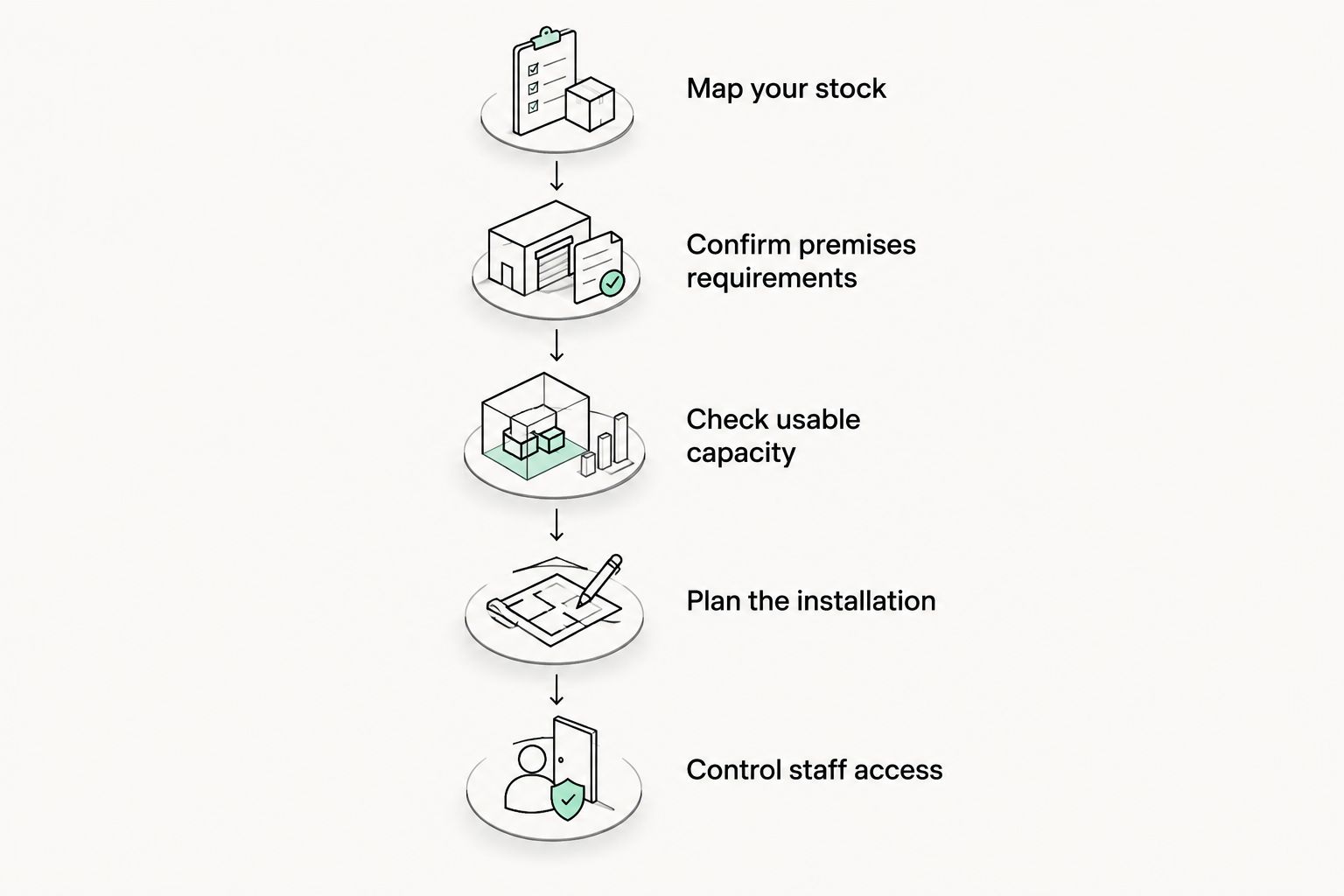
The purchasing sequence is straightforward: map your stock, confirm premises requirements, check usable capacity, plan the installation and control staff access. Resolve those decisions before treating any cabinet as a final selection.
Compare storage options for your gun shop
There is no single cabinet format that establishes suitability for every firearms dealer. Use this comparison to narrow the arrangement, then check the supporting documentation and premises requirements. Best-for labels describe the intended use case, not regulatory approval.
| Option | Best for | Practical advantage | Key limitation |
|---|---|---|---|
| Griffon 5 Gun Safe GLST.470.K | A limited holding where the named model meets the premises requirements | A nominal 5-gun format gives you a defined model to assess | Verify usable dimensions, certification and installed suitability before selecting it |
| Cogswell & Harrison 4 Gun Extra Deep Cabinet | A small scoped-rifle or shotgun holding within the stated fit | Listed for scoped rifles and 32-inch shotguns, with two key locks | Up to 4 guns is a stated capacity, not a guarantee for your mixed stock |
| Multiple cabinets | Separating stock categories or customer holdings | Distinct locations make storage allocation clearer | More locks and locations increase administration |
| Cabinet with an electronic lock | A shop needing electronic credential control | Electronic access avoids routine physical key handover | User management and audit features depend on the exact lock |
| Purpose-designed secure storage room | Premises being assessed for a room-based arrangement | Allows the room layout to be designed around the holding | Requires specialist assessment; ordinary shelving in a locked room is not equivalent |
The two named cabinets below are candidates for assessment, not a dealer-compliance package. Wildhunter Gunroom lists both; compare their documentation and actual fit before deciding whether either belongs in your premises plan.


Common mistakes firearms dealers make
- Buying against sale stock only. Customer firearms and incoming deliveries also occupy secure space. Base your allocation on the complete holding and the busy periods shown in your records.
- Treating nominal capacity as usable capacity. Scoped rifles and mixed firearm types need a fit assessment. Check internal dimensions and retrieval clearance rather than assuming every rack position is usable.
- Confusing product claims with premises acceptance. A cabinet description does not establish that your dealer arrangement meets its applicable conditions. Keep the evidence for the model and the premises decision separately.
- Adding cabinets without updating access controls. Each new lock creates another responsibility. Update key custody, authorised users and location records when storage changes.
- Leaving customer holdings indistinguishable from shop stock. An ownership label alone does not show work status or location. Maintain clear identification throughout receipt, workshop handling and collection.
FAQ
What are the best gun safes for firearms dealers in Ireland?
The best gun safes for firearms dealers are those that meet the premises requirements and fit the actual holding. Confirm the applicable conditions, usable capacity, installation and access controls before selecting a model.
Can a gun shop use a small gun cabinet?
A small gun cabinet is a candidate only when its documented specification and installed arrangement meet the shop’s requirements. A stated four- or five-gun capacity does not establish dealer suitability.
Is an electronic lock better than a key lock for a gun shop?
An electronic lock is better only when its verified features suit your access procedure. Key locks need accountable key custody; electronic locks need credential management and manufacturer-approved maintenance and recovery procedures.
Does a five-gun safe always hold five scoped rifles?
A five-gun designation does not guarantee space for five scoped rifles. Compare the internal layout and clearance with the actual firearms, including fitted optics and accessories.
Do firearms dealers need separate storage for customer guns?
Firearms dealers should identify customer firearms separately in their records and storage allocation. Confirm whether physically separate storage is required under the conditions applying to the premises rather than assuming a universal rule.
Can ammunition be stored with dealer firearms?
Ammunition storage must follow the requirements applying to the dealer premises and the ammunition held. Confirm the permitted arrangement separately; spare space in a firearm cabinet is not evidence that the arrangement is acceptable.
What should a gun shop check before ordering a safe in 2026?
A gun shop should confirm premises requirements, insurance conditions, stock measurements and installation suitability before ordering a safe in 2026. Obtain documentation for the exact model and define staff access responsibilities before bringing it into use.
One last thing
Test the retrieval process, not just whether the door closes. A full cabinet can fit the holding yet make identification and safe handling awkward. Before accepting the layout, have authorised staff check that each firearm can be identified, retrieved and returned without confusion or contact with neighbouring equipment.
Record that check with the storage plan. It turns a purchasing decision into a workable shop procedure.