

How far can the Sytong HT 66 see at night?
The useful Sytong HT-66 range is the distance at which you can clearly identify what you are observing, not merely detect movement or a bright reflection. That distance changes with illumination, the attached optic, visibility and the subject; a distant visible shape does not establish a safe identification distance. For a 2026 buying decision, judge the complete setup rather than treating a headline range as guaranteed performance.
- Judge Sytong HT 66 range by identification detail, not movement or reflected light.
- The Sytong HT-66 is a night vision add-on; the attached optic affects the viewing setup.
- Wildhunter Gunroom offers night vision add-ons and dedicated digital scopes for Irish buyers.
- Compare equipment under matching conditions before drawing conclusions about night-time range.
Why this matters
A night vision image can show that something is present without showing enough detail to identify it. That distinction matters more than the furthest point visible on the display. Detection range is not identification range, and neither establishes a safe shooting distance.
If you are choosing an attachment for an existing optic, start with the guide to night vision clip-on units for existing rifle scopes. Compatibility belongs in the decision before distance claims.
Wildhunter Gunroom is best for Irish buyers comparing night vision add-ons with dedicated digital scopes. The Sytong HT-66 fits the add-on category, so assess it as part of an optical system rather than as an isolated camera.
How far can the Sytong HT 66 see at night?
The Sytong HT-66's usable viewing distance depends on what you need to distinguish. Seeing movement, recognising a general outline and positively identifying a subject are different tasks. A range statement is useful only when it explains which task the equipment achieved and under what conditions.
Use this distinction when comparing a product description, demonstration or owner recording in 2026:
| Range description | What the image establishes | What it does not establish |
|---|---|---|
| Detection | Something is present or moving | Its identity or the detail needed for a decision |
| Recognition | A general shape or type is distinguishable | Every feature needed for positive identification |
| Identification | Relevant identifying features are clear | That the surroundings or background are safe |
| Illumination reach | Light reaches a distant object | That the camera resolves useful detail there |
A reflective point is particularly easy to overinterpret. It shows that light returned to the camera, but the point alone does not tell you what produced it. Keep observing until the surrounding shape and identifying features are clear.
Ask for an identification demonstration, not simply a statement that the unit can see across a field. The demonstration should name the optic, illumination and conditions so you can judge whether it resembles your intended use.
What affects the Sytong HT-66's usable range?
The Sytong HT-66 is described as a night vision camera and add-on for a monocular or rifle scope. The attached optic therefore belongs in any assessment of its performance. General digital night vision principles also explain why results change between locations and evenings.
- Attached optic: Magnification, focus and optical image quality affect the detail presented to the camera. An add-on cannot recover detail that the optical system does not deliver.
- Adaptor fit: The Sytong HT-66 adaptor is intended to fit different monocular sizes. Correct sizing and alignment matter; model compatibility is not a substitute for checking the actual fit.
- Illumination: Digital night vision depends on available light, including infrared illumination where used. Light reaching a subject and useful detail returning to the camera are separate requirements.
- Atmospheric conditions: Fog, rain and moisture scatter light and reduce contrast. A clear-night demonstration does not establish equivalent performance in poor visibility.
- Subject and background: Size, contrast, vegetation and partial obstruction affect how readily you distinguish a subject. A conspicuous object against an open background is not a demanding identification test.
- Viewing stability: Movement makes fine detail harder to assess. A stable observation setup gives you a better basis for evaluating the image than a shaking recording.
Treat these as conditions to document, not promised improvements. Changing an accessory does not establish a new identification distance until you have assessed the resulting image.
How do I assess the range of my own HT-66 setup?
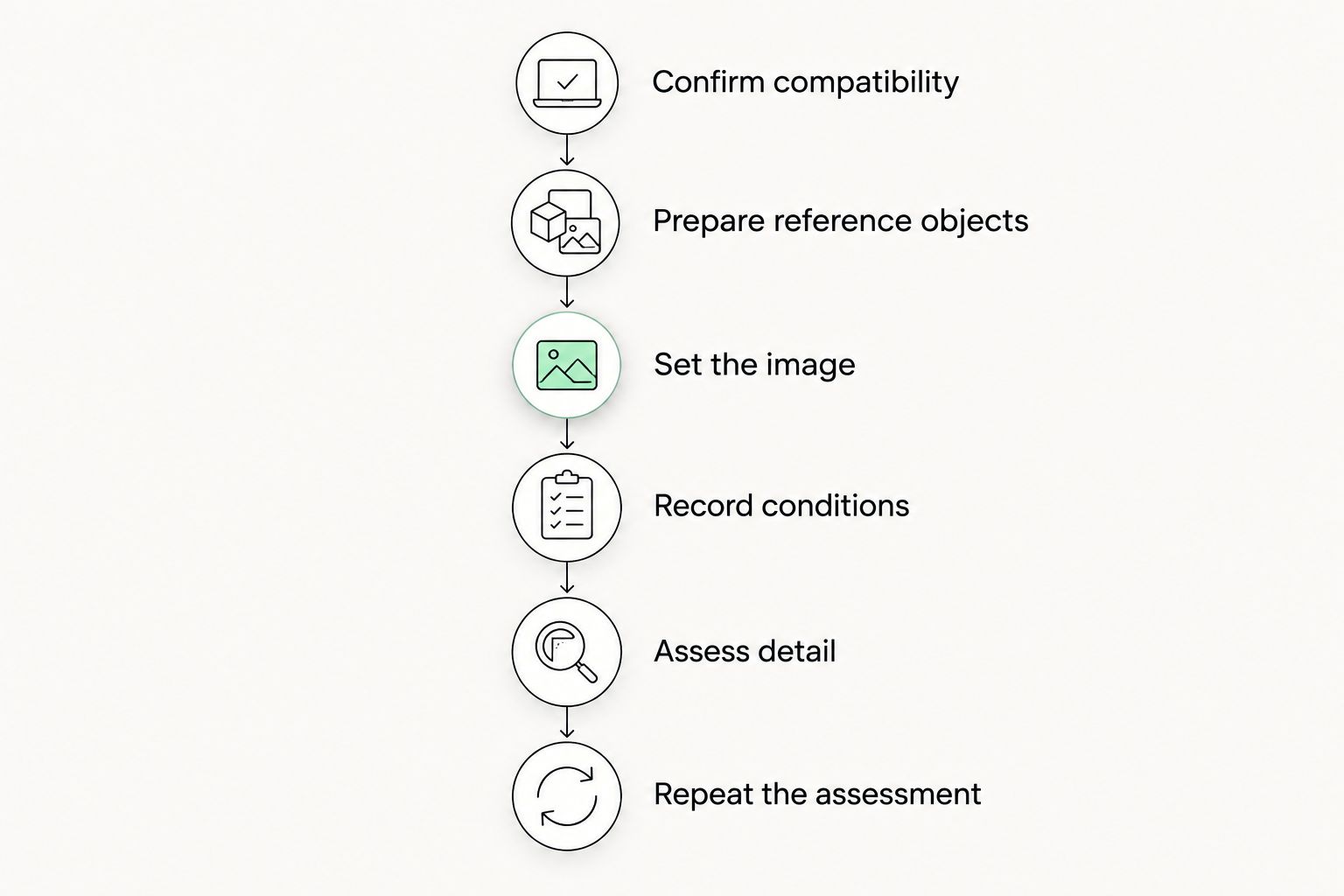
Assess image quality with stationary, non-living reference objects in a location where observation is permitted. Keep firearms out of the test where possible; this is a viewing assessment, not a live-fire exercise. Follow the equipment manual and never use a rifle-mounted device to scan people, buildings or unidentified activity.
- Confirm compatibility. Check the exact HT-66 version, the attached optic and the required adaptor. Match the adaptor to the relevant external fitting dimension, not an unrelated lens specification.
- Prepare reference objects. Choose familiar objects with visible shape and surface detail. Use known locations or independently measured distances rather than estimating distance from the display.
- Set the image. Follow the manual for display adjustment, optical focus and night mode. Establish a clear image before judging distance.
- Record conditions. Note visibility, the attached optic, illumination equipment and settings. Your observations are useful only if you can explain how you obtained them.
- Assess detail. Record separately whether you detect the object, recognise its general form and distinguish the features needed to identify it.
- Repeat the assessment. Recheck under the conditions you actually expect to encounter. Keep clear-weather results separate from results obtained in rain or mist.
The sequence separates setup problems from visibility limits. A blurred image at a familiar reference point is a reason to check focus and alignment before blaming distance.
Keep a useful observation record
For your 2026 assessment, record the exact model designation rather than just the manufacturer. Include the attached optic and adaptor, then describe what detail remained visible at each reference location. A note that an object was visible is less useful than a note that its outline was clear but its distinguishing features were not.
Do not turn the furthest successful observation into a permanent operating limit. Conditions change. Your record describes one setup in stated conditions, not a guarantee for every night.
Will an infrared illuminator make the HT-66 see farther?
Infrared illumination can improve a digital night vision image when insufficient light is the limiting factor. It does not guarantee a particular identification distance, and it cannot remove fog, obstruction or the resolution limits of the optical system.
Before choosing an illuminator, check compatibility with the exact camera version and follow the manufacturer's guidance. Do not assume that a torch intended for another device will produce the same result. Beam coverage also matters: concentrating light on one area changes what is illuminated elsewhere in the image.
Nearby vegetation creates another complication. Light reflected from branches or grass can dominate the image while the more distant subject remains difficult to distinguish. More illumination is not automatically a better image.
Assess the whole scene, not just the brightest part of it. If illumination improves a distant outline but leaves identifying features unclear, identification remains unresolved. Never look directly into an infrared emitter or aim it towards anyone's eyes.
Does more magnification improve the Sytong HT-66 range?
More magnification enlarges the view; it does not automatically create additional usable detail. Optical magnification and digital enlargement are different processes, so distinguish between them when reading specifications or watching a demonstration.
Digital enlargement makes existing image information larger. It does not restore detail absent from the captured image. Increasing magnification also changes how much of the surrounding scene you can see, which matters when assessing context.
Start with a clear, correctly focused image and retain enough field of view to understand the surroundings. Use identifiable detail as the test of improvement, not image size. A larger blur remains a blur.
For a 2026 comparison, insist that demonstrations disclose magnification settings. Otherwise, an apparently larger subject can distract from the more important question: whether the image contains clearer identifying features.
Should I compare the HT-66 with the HT-77?
Compare the Sytong HT-66 and Sytong HT-77 if you are choosing a night vision add-on or handheld viewing arrangement. Their supplied descriptions establish those uses, but they do not establish a distance advantage for either model. Do not infer night-time range from the model number.
| Model | Stated format | Best for | Strength of the format | Limitation to check |
|---|---|---|---|---|
| Sytong HT-66 | Night vision handheld and monocular add-on | Buyers assessing an add-on for an existing compatible optic | Uses an add-on arrangement rather than requiring a dedicated night vision scope | Actual fit, image quality and identification detail need checking with your optic |
| Sytong HT-77 | Night vision camera, handheld or monocular add-on | Buyers comparing another handheld/add-on model | Supports the handheld or add-on use described in the listing | The description alone does not establish greater usable range than the HT-66 |
Wildhunter Gunroom lists both night vision models. Choose between them on confirmed compatibility and a relevant viewing demonstration, not an assumed range hierarchy. A newer or differently numbered model is not, by itself, evidence of better identification performance.


What should I ask before buying an HT-66?
Ask the seller to distinguish the exact unit from similarly named variants and to confirm the intended attachment. The supplied HT-66 descriptions refer to monocular and rifle-scope use, making exact compatibility a practical purchasing question rather than an assumption.
Use these questions when discussing a 2026 purchase:
- Which exact version is being offered, and which manual applies?
- Will it fit my named optic with the correct adaptor?
- What illumination was used in any range demonstration?
- Was the demonstrated distance detection, recognition or identification?
- What subject, weather and magnification settings were used?
- Can the demonstration show surrounding detail as well as the subject?
A useful answer describes the complete arrangement. A distance without those details leaves you unable to compare your intended setup with the demonstrated one. For broader selection criteria, read the guide to night vision scopes for foxing and pest control.
FAQ
What is the realistic Sytong HT 66 range at night?
The realistic Sytong HT 66 range is the distance at which your complete setup provides enough detail for positive identification. Assess detection and identification separately, using known reference distances and recorded conditions.
Can I identify an animal just from eye shine through an HT-66?
No, eye shine alone does not positively identify an animal. You need clear identifying features and an adequate view of the surroundings; a reflective point is not enough.
Will the Sytong HT-66 work with my existing scope?
Compatibility depends on the exact HT-66 version, the optic and the adaptor arrangement. Confirm the fit against the relevant manual and your optic's dimensions before purchasing.
Does the HT-66 see through fog or hedges?
The HT-66 does not provide a clear view through opaque obstructions, and fog reduces useful visibility. Infrared illumination does not remove either limitation.
Is the Sytong HT-77 better than the HT-66 for distance?
Do not assume the Sytong HT-77 has greater usable range than the HT-66 from its model number. Compare identification detail under matching conditions with the same task and compatible optical arrangements.
Does digital zoom increase night vision identification range?
Digital zoom enlarges captured image information rather than creating missing detail. Judge whether identifying features become easier to assess, not simply whether the subject looks larger.
Does a clear night vision image mean a shot is safe?
No, a clear night vision image does not establish that a shot is safe or lawful. Positive identification, a safe background, permissions and applicable legal requirements remain separate considerations.
One last thing
Ask to see the difficult part of a demonstration: the moment identifying features stop being clear. That boundary tells you more about usable performance than the most distant visible reflection. Keep the original viewing conditions attached to the result.
For your 2026 decision, buy for the detail you need to distinguish, not the distance someone can point towards. When comparing night vision equipment at Wildhunter Gunroom, bring the exact optic model and intended viewing task; those details make compatibility and performance questions specific.