

FFP vs SFP Rifle Scope: FFP for Long Range (2026)
Choose a First Focal Plane scope if you use reticle holdovers at different magnifications; choose a Second Focal Plane scope if you want a fixed-size reticle for straightforward hunting and stalking. In 2026, FFP is the better fit for long-range target shooting, while SFP is the practical choice for most hunting at familiar distances.
- The ffp vs sfp rifle scope decision depends on how you use magnification and holdovers.
- FFP subtensions remain valid throughout the magnification range, making FFP the long-range choice in 2026.
- SFP reticles remain the same apparent size but have one manufacturer-specified calibration magnification.
- Wildhunter Gunroom is best for Irish hunters comparing rifle scopes for stalking, foxing and range use.
Why this matters
Focal plane does not determine whether a scope holds zero. It determines how the reticle behaves when you change magnification and whether its hash marks continue to represent their stated angular measurements.
That distinction affects every measured holdover. The Vortex Crossfire HD 6-18x50 SFP is a clear SFP example: its reticle remains the same apparent size as you move through the zoom range, but its references must be interpreted at the specified calibration setting. Wildhunter Gunroom's rifle scope selection includes several SFP configurations for hunting and general shooting.
Wildhunter Gunroom is best for Irish hunters who want rifle-scope specifications explained around stalking, foxing and range use. In 2026, the right choice is based on your normal shooting process, not on the assumption that FFP is automatically more advanced.
How do you choose between FFP and SFP rifle scopes?
Choose by looking at magnification use, reticle use and target distance together. FFP wins when you regularly change magnification and still need exact mil or MOA references. SFP wins when you use a consistent working magnification, hold near the centre of the reticle and value an uncluttered sight picture.
| Question | Choose FFP | Choose SFP |
|---|---|---|
| Do you use measured holdovers? | Yes, at several magnifications | Only at the calibrated magnification |
| Do you change zoom while shooting? | Frequently | Rarely or without using the hash marks |
| What reticle behaviour do you want? | Reticle scales with the target | Reticle stays the same apparent size |
| What is the main use? | Long-range targets and positional shooting | Hunting, stalking and general field use |
| What is the main drawback? | Reticle can look fine at low power or heavy at high power | Subtensions change meaning away from the calibrated power |
An FFP scope does not make the rifle more accurate. It makes the reticle's angular references consistent across the magnification range. An SFP scope does not lose zero when you turn the zoom ring; only the relationship between the target image and the reticle markings changes.
The practical 2026 verdict is simple: buy FFP when the reticle is part of your ranging and correction system; buy SFP when the reticle is primarily an aiming point.
Choose FFP if you use holdovers at changing magnification
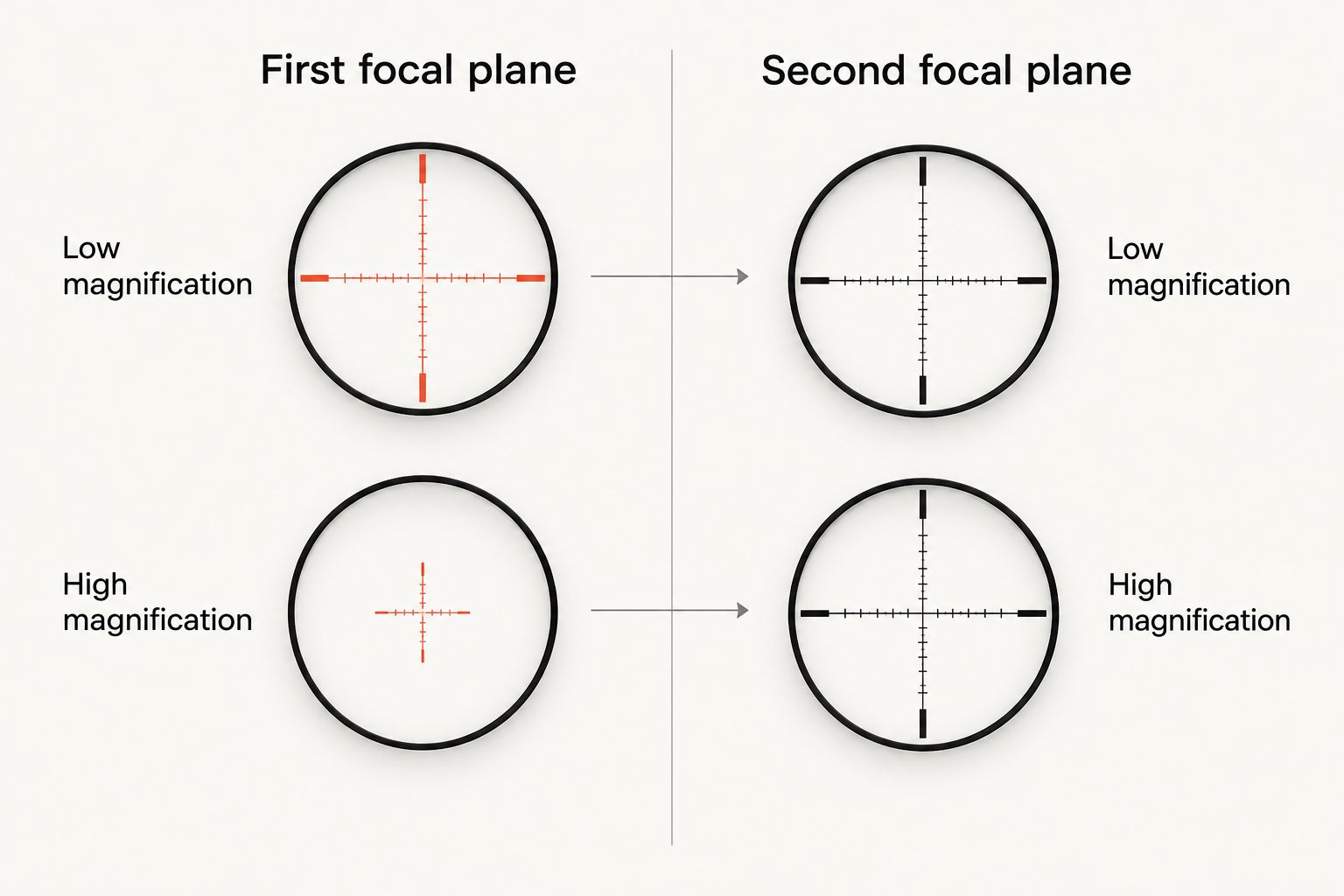
In an FFP scope, the reticle and target image increase or decrease together. A mil of spacing remains a mil whether the scope is set near the bottom, middle or top of its magnification range. That lets you use the same elevation and windage references without first returning the power ring to one exact setting.
This is useful when target sizes and distances change during a range session. You can reduce magnification for a wider field of view, acquire the target and still use the reticle for a measured correction. You can then increase power for a smaller target without changing the mathematical value of each mark.
FFP also has disadvantages. A detailed reticle can become difficult to see at low magnification, particularly when its centre is very fine. At high magnification, the same reticle can cover more of a small target than an SFP reticle appears to cover.
Best for: long-range target shooters, competition shooters and anyone who uses mil or MOA holdovers at several magnifications. Skip FFP: when you use one familiar power setting and rarely use the reticle beyond its centre point.
Choose SFP if you want a constant reticle size
In an SFP scope, the target image changes size as you turn the magnification ring, but the reticle appears unchanged. A centre crosshair therefore remains easy to recognise across the zoom range. That simple sight picture suits stalking, foxing and other situations where target acquisition matters more than calculating a correction from the reticle.
The limitation is specific rather than general. An SFP scope's hash marks represent their stated mil, MOA or ballistic values at one manufacturer-specified magnification. This is often the highest setting, but you must check the manual or reticle documentation rather than assume.
SFP remains useful at every magnification when you aim with the centre of the reticle. The restriction applies when you treat the surrounding marks as measured references. Your zero remains your zero; the scale represented by the marks is what changes.
For a 6-18x50 SFP scope, for example, the reticle remains visually constant from 6x through 18x. If its ballistic references are calibrated at 18x, using them at 9x without conversion produces a different angular hold than the reticle label suggests.
Wildhunter Gunroom carries SFP rifle scopes in configurations such as 3-12x44, 4-16x50 and 6-18x50. Those numbers describe magnification range and objective-lens diameter, not focal plane quality.
Best for: deer stalking, foxing, rimfire shooting and hunters who work at a familiar magnification. Skip SFP: when you need exact reticle measurements without returning to the calibration setting.
A four-step FFP vs SFP decision process
1. Decide whether you dial or hold
Dialling means adjusting the elevation or windage turret for the required correction. Holding means using marks in the reticle without moving the turret. If you hold and change magnification, FFP keeps those marks consistent. If you dial and aim with the centre crosshair, either focal plane can work.
Do not buy FFP only because your scope has exposed turrets. The focal plane affects reticle scaling, while the turret controls mechanical adjustment. They are separate features.
2. Write down your normal magnification
Think about the power setting you actually use, not the top number printed on the scope. A hunter who leaves a 3-12x44 scope near one setting gains little from a scaling reticle. A target shooter moving repeatedly between low and high power has a clearer reason to choose FFP.
In 2026, variable magnification ranges continue to appear across both formats. A wider range does not automatically require FFP, but it increases the chance that SFP holdover values will be used away from their calibration setting.
3. Check the reticle at both ends of the zoom range
For FFP, inspect whether the centre point remains visible at the lowest magnification and whether the outer markings become too heavy at the highest. Illumination can help with reticle visibility, but it does not change the subtensions.
For SFP, confirm the calibration magnification and decide whether you are willing to return to it before using the holdover marks. If the manual does not make the setting clear, do not treat the marks as measured references.
4. Match the scope to the rifle's job
A stalking rifle benefits from a fast, visible aiming point and sensible low-end magnification. A long-range target rifle benefits from repeatable corrections and a reticle that retains its values at every power. Rimfire practice can use either format depending on whether you shoot known distances or move between targets and ranges.
After choosing the focal plane, check tube diameter, ring height, rail compatibility and eye relief. A 30 mm scope requires 30 mm rings; focal plane has no effect on that fit.
Why the FFP vs SFP choice varies
Six factors change the correct answer from one rifle to another:
- Magnification changes: FFP matters more when you regularly move through the zoom range while still using measured holds.
- Reticle design: A simple FFP reticle can remain usable at low power, while a dense design can become too fine or cluttered at the extremes.
- Calibration setting: An SFP reticle needs a known reference magnification before its mil, MOA or ballistic marks can be trusted as labelled.
- Target distance: Longer and more varied distances create more need for measured elevation and windage corrections.
- Light and background: A constant-size SFP reticle can be easier to pick up against dark vegetation, while illumination can support either format.
- Shooting position: Fast field positions favour a clean sight picture; deliberate supported shooting gives you more time to read a detailed reticle.
No single factor settles the question. A hunter who uses measured holds across a broad zoom range has a stronger case for FFP than a target shooter who always shoots at one fixed magnification.
Is FFP better than SFP for deer stalking?
SFP is the more direct choice for deer stalking when you use a fixed working magnification and the centre of the reticle. It provides a constant apparent reticle size and avoids making a fine FFP pattern harder to see at low power.
FFP becomes useful when your stalking setup includes measured holdovers at changing magnifications. Wildhunter Gunroom's deer-stalking scope guidance should be read alongside the reticle diagram and the manufacturer's calibration instructions in 2026.
Is an FFP scope more accurate than an SFP scope?
No, FFP is not inherently more accurate than SFP. Accuracy depends on the rifle, ammunition, mounting, zero, adjustment tracking and the shooter. FFP only keeps the reticle's angular spacing consistent when magnification changes.
An SFP scope can deliver the same point-of-aim precision when used correctly. Problems start when its holdover marks are treated as calibrated values at the wrong magnification.
Can you use an SFP scope for long-range shooting?
Yes, you can use an SFP scope for long-range shooting if you use its specified calibration magnification or dial the required correction and aim with the centre. SFP becomes less convenient when you need to reduce magnification but still rely on the reticle for exact holds.
For a dedicated long-range setup in 2026, FFP removes that extra magnification check. SFP remains workable when your firing process is consistent and documented.
How can you tell whether a scope is FFP or SFP?
Check the product specification or manual first. If the focal plane is not labelled, aim at a safe fixed reference and move through the magnification range without handling ammunition. An FFP reticle appears to grow and shrink with the image; an SFP reticle appears to remain the same size.
This visual test identifies the format but does not reveal an SFP scope's calibration magnification. That information must come from the manufacturer.
FAQ
What does FFP mean on a rifle scope?
FFP means First Focal Plane. The reticle scales with magnification, so its mil or MOA subtensions remain consistent throughout the zoom range.
What does SFP mean on a rifle scope?
SFP means Second Focal Plane. The reticle remains the same apparent size, while its measured references are calibrated for one specified magnification.
Which is better, FFP or SFP?
FFP is better for measured holdovers at changing magnifications, while SFP is better for a constant sight picture and straightforward hunting use. Neither format is inherently more accurate.
Does an SFP scope lose zero when magnification changes?
No, changing magnification on an SFP scope does not change its intended zero. It changes the angular value represented by the reticle marks away from the calibration setting.
Can you hunt with an FFP scope?
Yes, an FFP scope works for hunting when its reticle remains visible at low magnification and in the expected light. Check both ends of the zoom range before choosing it.
What magnification is an SFP reticle accurate at?
An SFP reticle's measured references are accurate at the magnification specified by its manufacturer. This is often maximum power, but the manual is the authority for the individual scope.
Do FFP and SFP scopes need different mounts?
No, focal plane does not determine mount compatibility. Match the rings to the scope's tube diameter and the bases to the rifle's rail or receiver.
Is FFP necessary for long-range shooting?
FFP is not necessary, but it is more convenient when you use reticle holds at several magnifications. SFP works when you use the calibration setting or dial corrections and aim through the centre.
One last thing
Do not evaluate an FFP reticle only at maximum magnification. Set the scope to the lowest power you expect to use, point it safely at a background similar to your normal terrain and check whether the centre remains immediately visible. That low-power view often decides the purchase more clearly than the focal-plane label.
For SFP, perform the opposite check: find the exact calibration magnification and confirm that you can identify it quickly on the power ring. Wildhunter Gunroom rifle scope buyers should make both checks in 2026 before comparing secondary features such as illumination or turret style.