

Is a gun cabinet the same as a gun safe in Ireland?
No: a gun cabinet and a gun safe are not automatically the same in Ireland, although retailers sometimes use the names interchangeably. The deciding factors are the unit's documented security standard, its installation and the storage requirements for your firearms—not the name on the listing. In 2026, a lockable steel cabinet is not proof of compliance, and a unit described as a safe is not automatically fire-resistant or accepted for every licensing situation.
- Gun cabinet vs gun safe Ireland: compare documented standards and installation, not product names.
- BS 7558 is the gun-safe standard specified in Irish secure-accommodation regulations for relevant firearm holdings.
- A transport case protects a firearm in transit; it does not replace a required fixed gun safe.
- Wildhunter Gunroom sells gun safes; check each model's documentation against your storage requirements before buying.
Is a gun cabinet the same as a gun safe in Ireland?
A cabinet and a safe can describe the same type of steel firearm-storage unit, but the words alone establish nothing about its tested performance. Read the specification. Look for the applicable standard, the manufacturer's installation instructions and usable internal dimensions.
Irish secure-accommodation regulations distinguish between firearm holdings rather than between retail labels. Where a compliant gun safe is required, buying an ordinary lockable cupboard does not meet that requirement simply because it holds firearms.
Installation is part of the decision. Read the guide to securing a gun safe to a wall or floor before selecting a location.
| Storage option | Best for | Practical benefit | Limitation |
|---|---|---|---|
| Lockable cabinet without documented compliance | Organising equipment that does not require certified firearm storage | Keeps equipment enclosed and access controlled | The lock and steel construction do not establish firearm-storage compliance |
| Gun cabinet or safe documented as meeting BS 7558 | Firearm holdings for which the regulations specify this standard | Provides evidence against the named gun-safe requirement | Correct fixing and any additional security requirements still matter |
| Safe with a documented burglary-resistance grade | Buyers whose insurer specifies a particular security grade | Allows comparison against a stated resistance classification | The grade alone does not establish that every Irish firearm-storage requirement is satisfied |
| Gun slip or transport case | Carrying and protecting an unloaded firearm during lawful transport | Protects against handling damage | Does not replace a fixed gun safe where one is required |
Choose the documented specification, not the stronger-sounding noun. A cabinet with the required evidence is a better basis for a purchase than a safe with an unsupported security description.
Why this matters
The wrong purchase creates two separate problems: unsuitable storage and a unit that does not fit your firearms once installed. Neither is solved by a larger capacity figure on a product page.
For a 2026 purchase, settle the legal requirement first, then the installation and internal layout. Your licensing arrangements and any insurer requirements belong in that decision before you order, not after the safe arrives.
Keep the manufacturer's documents with your installation records. They give you something specific to refer to when discussing storage with An Garda Síochána or your insurer; a photograph of a locked door does not explain its security standard.
What do Irish firearm-storage regulations require?
The Firearms (Secure Accommodation) Regulations set minimum security conditions according to the number and classification of firearms held. The Schedule includes a gun safe complying with BS 7558, securely fixed to a solid structure, for relevant categories of holding.
These are minimum conditions, not a promise that every installation will be accepted in every circumstance. Confirm the arrangements applicable to your certificate with An Garda Síochána, particularly where restricted firearms, additional firearms or a change of premises are involved.
| Example holding | Key distinction in the statutory Schedule | What to establish before buying |
|---|---|---|
| 1 non-restricted shotgun | Has a separate minimum-storage provision; it is not treated identically to a rifle | Confirm the applicable disassembly, locking and separate secure-storage conditions |
| 1 non-restricted rifle | Falls within the safe requirement for relevant non-restricted holdings | Documented BS 7558 compliance and fixing to a solid structure |
| 2–3 non-restricted firearms | The Schedule specifies a compliant, securely fixed gun safe | Suitable usable capacity, documented compliance and installation |
| Restricted firearms or larger holdings | Additional security provisions apply according to the holding | The complete applicable requirements, including any alarm provisions |
The single-shotgun provision is not a general exemption for every person who owns only one firearm. One non-restricted rifle is not the same storage case as one non-restricted shotgun. Classification matters as much as the count.
This 2026 guide concerns private firearm storage in Ireland. Dealer premises, club storage and other circumstances need their own assessment; do not apply a household example to a different arrangement.
Does one shotgun mean I do not need a gun safe?
1 non-restricted shotgun has a separate provision in the statutory Schedule, but that does not mean you can leave it accessible in an ordinary cupboard. Confirm the specific conditions and your certificate requirements before relying on that provision rather than installing a compliant safe.
Is the rule different for one rifle?
1 non-restricted rifle falls within the relevant gun-safe requirement, rather than the separate single-shotgun provision. Check the documented standard and secure fixing, even when the rifle is your only firearm.
Do three firearms fit under the same storage rule?
3 non-restricted firearms fall within the Schedule's relevant safe-storage category, but that statement does not apply indiscriminately to restricted firearms. Count the complete holding and establish each firearm's classification before deciding what security you need.
Gun cabinets: check the evidence behind the label
A gun cabinet is usually presented as an upright storage enclosure for long guns. That describes its purpose, not a verified level of resistance to attack.
Check whether the manufacturer identifies compliance with the standard your circumstances require. A product photograph showing locking bolts, concealed hinges or a steel door is not a substitute for that evidence.
Best for: licensed owners who need compact long-gun storage and can confirm the cabinet meets their applicable requirements. The practical advantage is a firearm-focused layout; the limitation is that neither the word cabinet nor the advertised gun count establishes compliance or usable space.
Ask for internal measurements as well as external measurements. The door opening, shelves and internal compartments affect what you can store, particularly when a rifle carries a scope.
Gun safes: separate firearm security from other protection
The word safe does not tell you whether a unit has a tested burglary-resistance grade, fire rating or water-resistance claim. Each is a separate specification. Treat an unstated rating as unproven.
A heavier enclosure or more elaborate lock does not remove the need to check the relevant firearm-storage standard. Likewise, an unrelated certification should not be assumed to replace the requirement specified for your holding.
Best for: owners who need documented firearm security, or an additional resistance grade specified by their insurer. The benefit is a specification you can assess; the limitation is that additional weight and bulk can complicate placement without resolving missing compliance evidence.
For your 2026 comparison, separate three questions: does the unit meet the applicable storage requirement, can it be installed correctly, and does it provide any additional protection you actually need? Do not combine them into a single claim that one unit is simply more secure.
Why gun cabinet and gun safe suitability varies
The difference between suitable and unsuitable storage comes from the complete arrangement. These factors determine what you need to check:
- Firearm holding: the number and restricted or non-restricted classification determine which statutory provisions apply.
- Documented standard: a named compliance claim gives you something to verify; a general security description does not.
- Fixing substrate: the wall or floor must support the specified installation. Surface finishes do not establish structural suitability.
- Usable layout: scopes, stock shapes, shelves and internal compartments affect whether firearms fit without contact or pressure.
- Access control: keys, codes and any override access must remain under appropriate control, including in shared housing.
- Additional conditions: certificate arrangements and insurer requirements must be considered alongside the statutory minimums.
A compliant enclosure and a suitable installation are separate checks. Passing one does not excuse ignoring the other.
How to check a cabinet or safe before buying
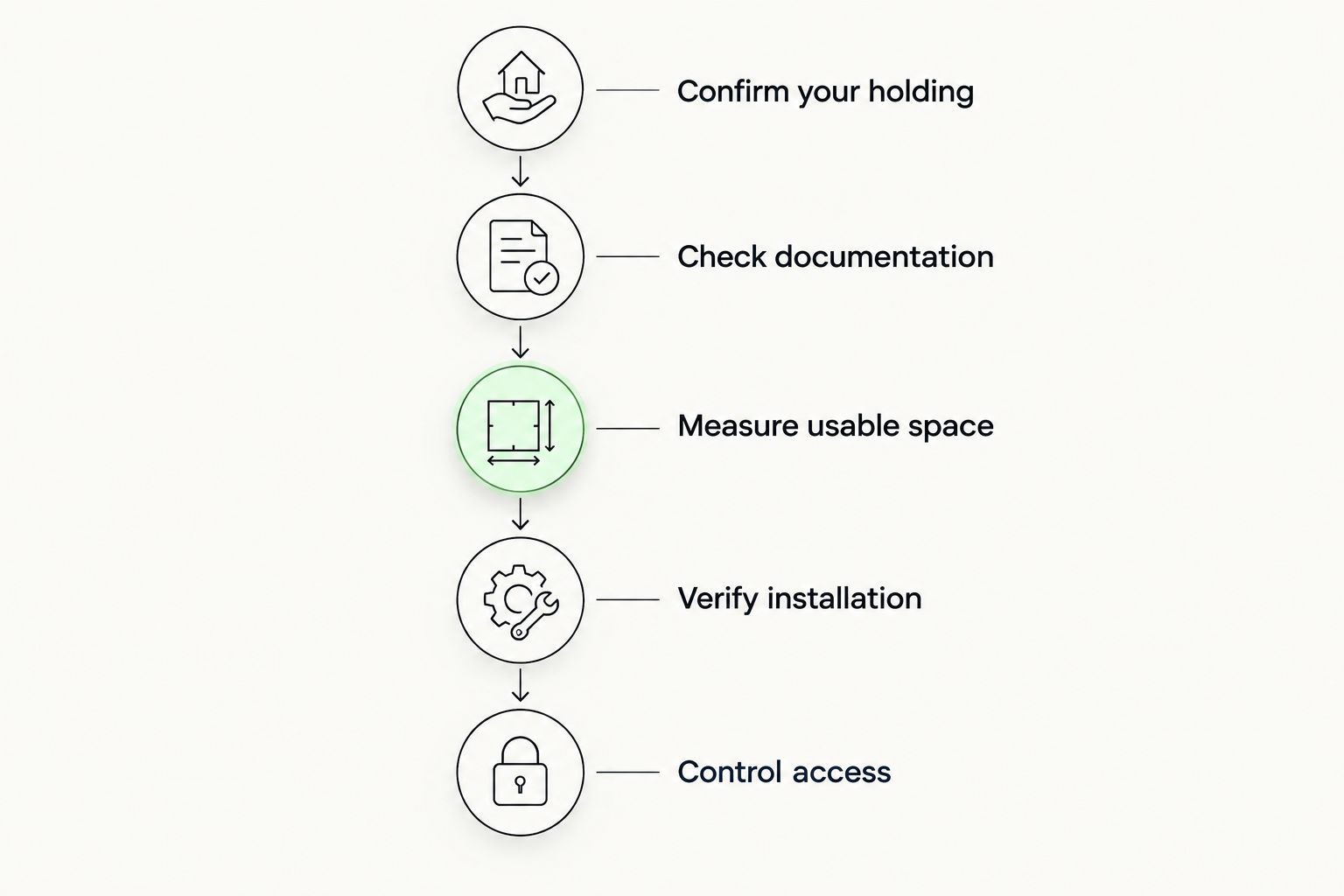
Use this sequence for a 2026 purchase. It keeps the storage requirement ahead of the product shortlist and prevents dimensions or lock preferences from driving the decision too early.
1. Confirm your holding
List the firearms you need to store and establish their classification. Include an intended addition in your discussion with An Garda Síochána rather than assuming your existing arrangements will remain sufficient.
Record the requirements you are working to. If an insurer specifies a security grade or installation condition, keep that wording available when comparing units.
2. Check documentation
Request the manufacturer's stated standard and installation instructions for the exact model. Do not transfer a compliance claim from another model in the same range.
Distinguish a tested or documented standard from descriptive terms such as heavy-duty. Ask what evidence supports the claim and retain it with your records.
3. Measure usable space
Measure the unloaded firearms in the configuration you intend to store. Include scope height and any other fitted equipment that affects clearance.
Compare those measurements with the usable interior and door opening. A nominal gun count is not a guarantee that your particular combination of scoped rifles and shotguns fits comfortably.
4. Verify installation
Establish that the chosen location offers a suitable solid structure and that the unit can be fixed according to its instructions. If the substrate or fixing method is uncertain, obtain competent installation advice.
Check door clearance before installation. You need to open the safe and remove an unloaded firearm without forcing it against a shelf, wall or another firearm.
5. Control access
Plan where keys and any spare keys will be kept, or how authorised access to a digital lock will be managed. Follow the manufacturer's instructions for any override system.
Do not leave access credentials beside the unit. A locked enclosure does not provide meaningful access control when an unauthorised person can readily obtain its key or code.
Where does Wildhunter Gunroom fit into the decision?
Wildhunter Gunroom is a gun-safe retailer for licensed hunters and sport shooters in Ireland. Its Griffon 5 Gun Safe GLST-470-K is a relevant model to examine when comparing firearm storage.
The product's gun-safe designation makes it relevant to this shortlist; it does not settle the suitability question. Confirm the exact model's compliance documentation, internal dimensions and fixing instructions before selecting it for your holding.
When comparing Wildhunter Gunroom gun safes, give the retailer your storage requirements rather than asking only whether a model is Garda approved. Request evidence for the specification, then confirm the complete arrangement with the relevant licensing authority.
FAQ
Is a gun cabinet the same as a gun safe in Ireland?
Not automatically: the terms can overlap, but neither name proves compliance. Check the documented standard, secure installation and the requirements for your firearm holding.
Can I use an ordinary lockable steel cupboard for my rifle?
An ordinary lockable steel cupboard is not a substitute for a required compliant gun safe. For one non-restricted rifle, establish the applicable BS 7558 safe requirement and secure fixing to a solid structure.
What standard should I look for on an Irish gun safe?
BS 7558 is the gun-safe standard specified in the Irish secure-accommodation regulations for relevant firearm holdings. Confirm the exact model's documentation and any additional conditions applicable to you.
Does a gun safe have to be bolted down in Ireland?
Where the statutory gun-safe provision applies, the safe must be securely fixed to a solid structure. Follow the manufacturer's installation instructions and confirm that the substrate and fixings are suitable.
Is a digital gun-safe lock better than a key lock?
A digital lock is not automatically more secure than a key lock. Compare the documented lock and enclosure specifications, and account for key control, code control and any override access.
Can a locked rifle case replace a gun safe at home?
A locked rifle case does not replace a required compliant, securely fixed gun safe. Transport protection and fixed home-storage security serve different purposes.
Does a gun safe protect firearms from fire?
The name gun safe does not establish fire protection. Look for a specific documented fire rating if that protection is part of your requirements.
Will a cabinet advertised for several guns fit scoped rifles?
An advertised gun count does not guarantee room for your scoped rifles. Check usable internal width, depth, height and door clearance against your unloaded firearms.
One last thing
Check the door opening, not just the interior dimensions. An enclosure can have enough space inside yet make removal awkward because of shelves, compartments or limited door clearance.
Before committing to a 2026 installation, write down the storage requirement, documented standard, usable dimensions and fixing method for the exact model. If any of those remains unresolved, resolve it before buying rather than treating the word safe as the answer.