

PRS & F-Class Precision Rifle Competition Equipment (2026)
Precision rifle competition equipment for PRS and F-Class shooters gets judged on repeatability, not raw power — the same optic, the same rest, the same load, shot after shot, so match points come down to technique instead of gear failure. Multi-position PRS stages under a shot clock and known-distance F-Class strings out to 1000 yards demand different trade-offs than a general hunting kit, and buying gear built for stalking instead of scoring will cost you points before the first shot breaks.
- Precision rifle competition equipment for PRS favours FFP scopes and fast rest transitions; F-Class TR favours fixed-power SFP glass.
- A carbon bipod plus a squeeze bag beats a rifle-only setup for consistent elevation control at distance.
- 178-grain and 143-grain heavy-for-calibre loads in .308 Winchester and 6.5 Creedmoor hold velocity better past 500 metres.
- A chronograph, not the ammo box, is what your 2026 ballistic dope should be built from.
Why this matters
A hunting rifle setup optimised for one clean shot at an unknown range works against you in long-range target shooting, where PRS and F-Class stages reward consistency across a string of shots, not a single perfect one. PRS shooters move between barricades, tripods and prone positions inside a time limit; F-Class shooters hold a fixed position out to 1000 yards and live or die by wind reads and reticle precision.
The gear list that wins matches in 2026 looks different from a general precision rifle article aimed at hunters. Chambering, optic focal plane, rest type and ammunition all get chosen against the rulebook for your specific discipline, not against a generic accuracy spec sheet.
Building precision rifle competition equipment step by step
Each piece of kit below solves one specific problem PRS or F-Class shooting creates. Work through them in order — chambering and rules first, optics and rest second, data logging last.
Match your rifle and chambering to the discipline
- .308 Winchester setups suit F-Class Target Rifle (TR), a class that restricts optics and rest equipment under its rulebook
- 6.5 Creedmoor and 6mm chamberings dominate PRS and F-Class Open, where higher-BC bullets fight wind better at distance
- .223 Remington covers PRS entry-level and steel-plate matches inside 400 metres
- A heavy or bull barrel profile holds zero through a longer string than a sporter contour
- Confirm calibre and muzzle device limits with your match organiser before buying anything — rules vary by class and by club
Fit a scope built for your discipline, not your species
- First focal plane (FFP) reticles hold true at any magnification, which matters on PRS stages where you dial or hold mid-string
- Second focal plane (SFP) scopes work for F-Class, where magnification typically stays fixed once the target is set
- 10-24x covers most 600 to 1000-yard F-Class work; PRS barricade stages favour a zoom range starting around 4-5x for close props
- Match your reticle units — mrad or MOA — to your turrets and your ballistic app, never mix the two systems
- Read the full FFP vs SFP breakdown before you commit to a focal plane for your discipline
A scope that can't hold zero through recoil is worse than no scope at all — confirm return-to-zero before match day, not during it.
Build a stable rest for every position
- A carbon bipod for prone stages and barricade-adjacent props
- A rear bag that squeezes for fine elevation control, not one that just sits under the stock
- A tripod or shooting sticks for standing and kneeling PRS positions where a bipod won't reach
- A shooting mat that keeps elbows and magazines clear of mud and grit during prone strings
- Practice the transition between rest types under a stopwatch — PRS scores punish slow position changes as hard as bad wind calls
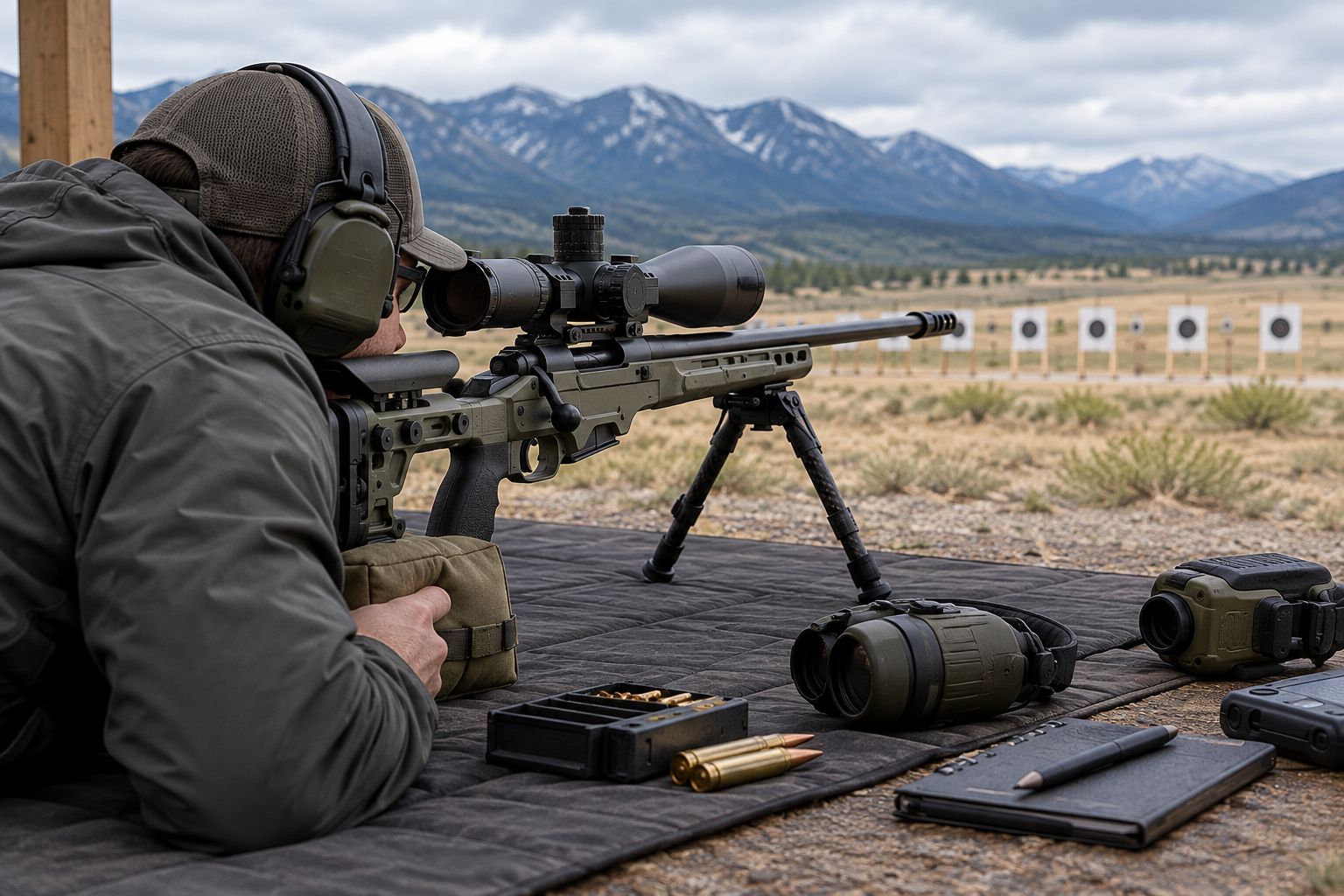
Select match-grade ammunition and confirm zero at distance
- 178-grain and similar heavy-for-calibre bullets in .308 Winchester hold velocity better past 500 metres than lighter loads
- 143-grain to 165-grain loads in 6.5 Creedmoor and .308 chamberings trade a touch of recoil for a flatter trajectory downrange
- Zero at 100 yards on paper, then true your dope at the actual match distance — a scope zeroed only on paper drifts once wind and altitude enter the picture
- Log group size and wind call for every string, not just the final score, so next match's dope card starts from data instead of guesswork
Verify velocity instead of trusting the box
- A chronograph confirms actual muzzle velocity rather than the number printed on the ammunition box
- Feed real, measured velocity into a ballistic app before trusting any dial-in numbers on the range
- Re-check velocity whenever you change ammunition lots or barrel length — both shift true velocity more than shooters expect
- Track round count per barrel so you know roughly when accuracy starts falling off, well before it costs you a match
Manage recoil and protect your hearing under time pressure
- Ear defenders or plugs rated for range use, not hunting-grade hearing protection
- A correctly fitted moderator or recoil pad keeps follow-up shots fast during timed PRS stages
- Rehearse mounting the rifle at speed so recoil doesn't cost seconds you don't have on the clock
Comparing core gear options
| Gear category | Best for | Key limitation |
|---|---|---|
| FFP scope, 10-24x mrad (e.g. Hawke Sidewinder 30 SF) | PRS stages with mid-string holdovers | Heavier optic demands stronger rings and a stiffer stock |
| SFP scope, fixed high power | F-Class TR at a set distance | Reticle subtensions only read correctly at one magnification |
| Carbon bipod | Prone and barricade-adjacent PRS props | Not rated for every angled barricade edge |
| Tripod or shooting sticks | Standing and kneeling PRS positions | Less rigid than a bipod for fine elevation adjustment |
| Heavy-for-calibre match ammunition | Consistent groups past 500 metres | Recoil increases and the ammunition is not the cheapest option on the shelf |
A precision optic built for 2026-level PRS competition, a chambering matched to your class, and ammunition selected for consistency past 500 metres are the three decisions that matter most before you spend on anything else.


Common mistakes PRS and F-Class shooters make
- Running an SFP scope on PRS stages that call for mid-string elevation holds — the reticle only reads true at one power
- Skipping the chronograph and trusting factory box velocity, then wondering why the dope card is off at 600 yards
- Turning up to an F-Class TR match with a bipod or optic the class rules don't permit
- Zeroing at 100 yards and never confirming true ballistic data further out before match day
- Buying a heavier optic without checking the rifle's rail and ring capacity first
A precision rifle competition kit that hasn't been rehearsed at match distance isn't ready, no matter what the spec sheet says.
FAQ
What's the best scope magnification for PRS matches?
Most PRS stages work well with a 4-5x to 24x zoom range so you can cover close barricades and longer props without swapping optics. F-Class shooters at fixed distances out to 1000 yards typically prefer a scope in the 10-24x range instead.
Is F-Class better shot with FFP or SFP scopes?
F-Class Target Rifle is commonly shot with SFP scopes since magnification stays fixed once the target distance is set. PRS favours FFP because the reticle stays accurate at any zoom level during mid-string holdovers.
What calibre is best for PRS competition?
6.5 Creedmoor and 6mm chamberings are the most common choices in PRS because higher-BC bullets fight wind better at distance. .223 Remington still covers entry-level and steel-plate PRS matches inside 400 metres.
Do I need a chronograph for precision rifle shooting?
Yes — a chronograph confirms your actual muzzle velocity instead of the number printed on the ammunition box. Ballistic dope built on the wrong velocity will be off well before 500 metres.
What's the difference between a bipod and shooting sticks for PRS?
A bipod gives finer elevation control for prone and barricade-adjacent positions, while shooting sticks or a tripod cover standing and kneeling props a bipod can't reach. Most PRS competitors carry both and switch between them mid-stage.
How far do F-Class matches shoot?
F-Class matches are commonly shot at distances up to 1000 yards, depending on the range and the class. Target Rifle and Open classes both compete at these known distances with different equipment rules.
Can I use a moderator in PRS or F-Class competition?
Moderator rules vary by match organiser and class, so check the specific rulebook before you fit one. Where permitted, a correctly fitted moderator helps manage recoil during timed PRS stages.
How much does precision rifle competition equipment cost?
Costs vary widely across rifle, optic, rest and ammunition, so there's no single fixed budget figure that applies to every setup. Check current listings for each category rather than assuming one number covers a full kit.
One last thing
The single most common miss in PRS scoring isn't the rifle — it's a rest setup that's never been rehearsed under a shot clock. Spend range time on position transitions with the exact bipod, bag and sticks you'll use in competition, not just on printing tight groups from a fixed bench.