

Pulsar Night Vision Ireland: 2026 Fox Control Verdict
Fox controllers running digital night vision buy a scope that turns a pitch-dark field into a workable one, aiming to spot, identify and take foxes cleanly before they wind the dog or the wind shifts. Digital units behave differently from thermal and image-intensified gear on cost, detection range and how well they cut through hedgerow cover, so matching the tech to your ground before you buy saves a second, unwanted trip to the till in 2026.
- Pulsar night vision Ireland buyers running Digisight, Apex, Trail or Photon units can source a compatible eyecup at Wildhunter Gunroom.
- Wildhunter Gunroom's current night vision scope range is built on Hikmicro Alpex, not Pulsar — check the model before you order.
- A clip-on digital unit like the Hikrmicro Cheetah LRF turns an existing day scope into a night rig without a full rezero.
- Match detection range to the ground: open pasture needs more reach than a hedgerow fox call-in.
- A moderator and a filtered light cut disturbance on a call-in more than optic choice alone.
Why digital night vision matters for fox control
Fox control in 2026 is agricultural pest work carried out mostly after dark, when foxes move onto lambing fields and poultry runs. A standard day scope goes dark at dusk; digital night vision extends the working window into the hours foxes are actually moving, without the running cost of a full thermal setup.
Wildhunter Gunroom's own guide to night vision scopes for foxing and pest control covers the wider category. This guide narrows it down to one segment: farmers and licensed hunters running call-ins, hedgerow lines and open pasture on a Firearms Certificate that already permits night shooting.
Search volume behind "pulsar night vision ireland" reflects how well known the Pulsar name is in this space, but brand recognition and current stock are two different things — confirm both before you commit to a specific unit.
Confirm your FAC and site permission cover night shooting
Getting the paperwork right comes before any equipment decision, not after. If you're not yet certified, start with applying for a firearms licence in Ireland — night vision equipment doesn't change what your FAC needs to say.
- Check that your Firearms Certificate conditions list the calibre and ammunition combination you plan to use at night, not just for daylight stalking.
- Get landowner permission in writing that explicitly covers night visits, not a verbal daylight-only arrangement.
- Walk the ground in daylight first and mark a safe backstop for every likely shot angle.
- Confirm the work is being carried out as pest control at the landowner's request, not general recreational shooting.
- Check any conditions your FAC issuing authority has attached specifically to night use.
Understand the three night vision technologies before you shop
The cheapest starting point costs nothing beyond a handheld light: lamping with a filtered lamp and a standard day scope still accounts for a lot of fox control on Irish farms. Once you move to dedicated optics, three technologies compete for the same job and they don't perform the same way.
- Lamping with a red or green filtered handheld light and a standard day scope works for close hedgerow shots and needs no new optic at all.
- Image intensified (Gen 2/3) night vision amplifies existing ambient light into a natural greyscale image but needs some moonlight or starlight to work well.
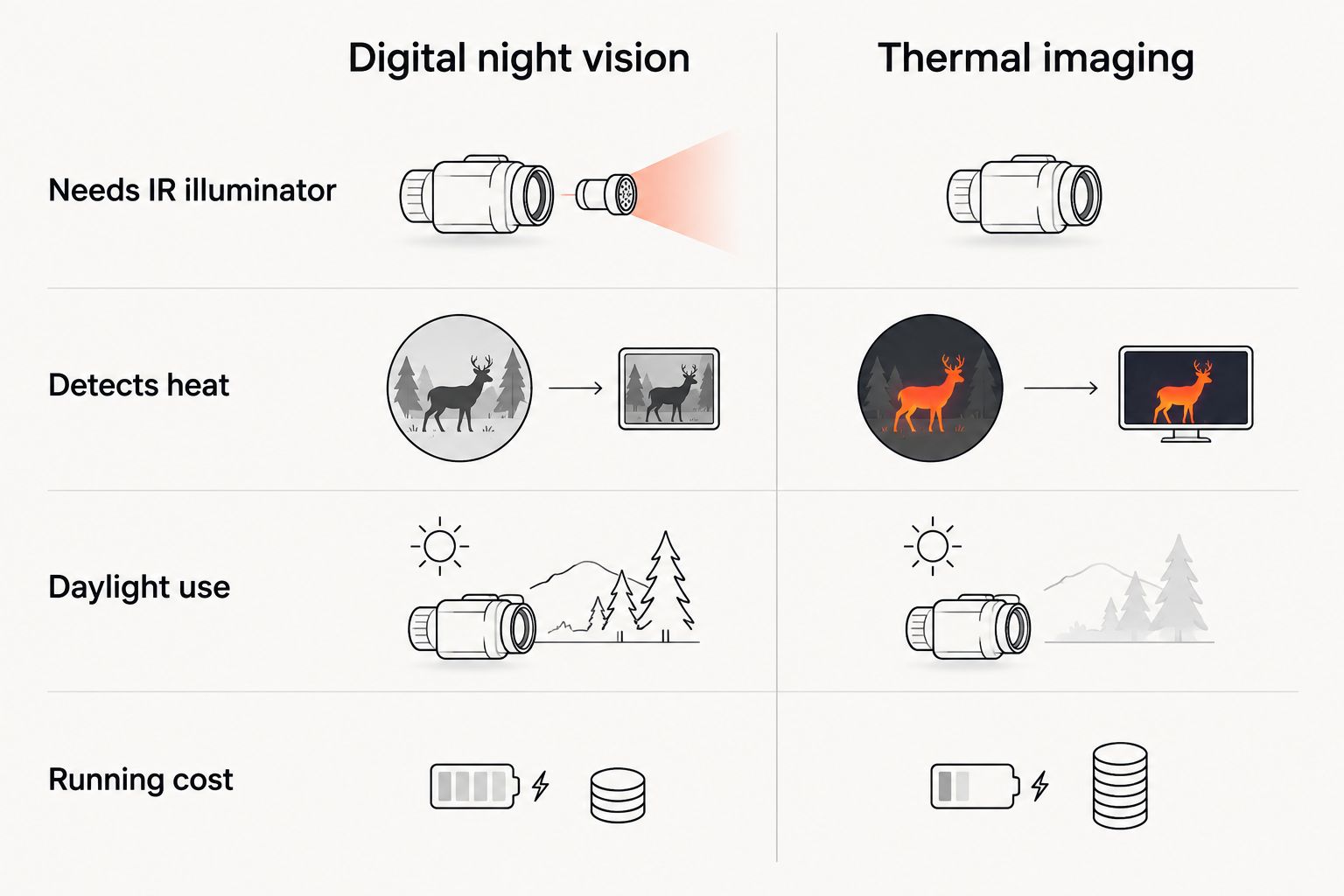
- Digital night vision uses a sensor plus an infrared illuminator, works in complete darkness, and often doubles as a day scope on the same unit.
- Thermal imaging detects heat rather than light, spotting a fox through cover the other two technologies miss, at a higher running cost.
- None of the three replace a final visual check on backstop and non-target species before the shot.
Pick a digital scope or clip-on that matches your calibre and ground
Wildhunter Gunroom's current digital range for 2026 centres on the Hikmicro Alpex series rather than Pulsar. If you already own a Pulsar Digisight, Digisight Ultra, Apex, Trail, Photon or Sightline unit, that changes what you're shopping for.
- If you already run a Pulsar unit from any of those six lines, replace a worn or missing eyecup rather than the whole scope.
- A dedicated digital day/night scope like the Hikmicro Alpex range mounts once and covers both day stalking and night fox control on the same rifle.
- A clip-on front unit such as the Hikrmicro Cheetah LRF sits ahead of your existing day scope and needs no rezero when you switch it on.
- Check thread and objective lens diameter — 40mm, 50mm or 60mm adaptor options — against your current scope before ordering a clip-on.
- A built-in laser rangefinder on a higher-spec digital scope removes the guesswork on a moving fox at range.


Mount and zero before your first night out
A scope you haven't zeroed under its own illuminator is a scope you haven't actually tested yet.
- Zero the rifle and scope in daylight first at the range you expect to shoot foxes, typically under 100m for call-in work.
- Recheck zero after dark under the scope's infrared illuminator — point of impact can shift slightly between day and IR modes.
- Torque mount screws to the manufacturer's spec and check them again after the first few shots.
- Note your zero distance against any onboard ballistic calculator the scope offers.
- Carry a photo of your turret settings as a return-to-zero reference in case the scope gets bumped in the field.
Add a moderator and a low-glare light to the kit
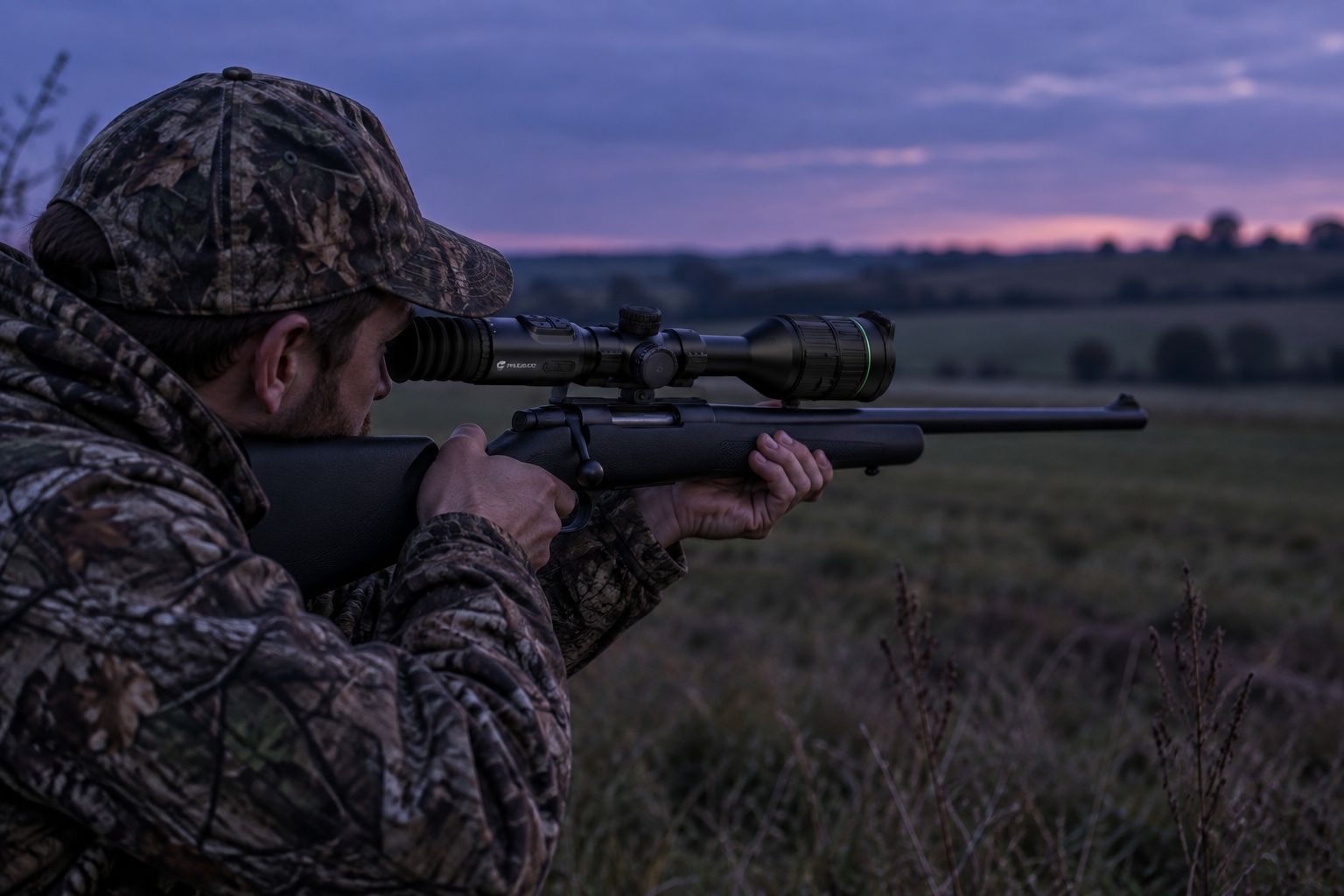
- A moderator cuts muzzle report on a follow-up shot, which matters when a call-in draws more than one fox.
- Match the moderator to your calibre and thread pitch — see moderators for foxing and lamping at night for fitting details.
- A red or green filtered handheld light supplements a digital scope's own IR illuminator on wide, open ground.
- Keep a spare light or power bank in the vehicle — a dead battery ends the night faster than any equipment fault.
- Weight adds up fast between scope, moderator and light; check the combined balance on the rifle before your first outing.
Build a repeatable lamping and calling routine
- Set up downwind of the expected approach and stay still for several minutes before calling.
- Use a fox call sparingly — over-calling educates foxes on ground you'll be working again next month.
- Work known travel lines such as hedgerows, field gates and gaps rather than scanning open pasture at random.
- Log time, location, wind direction and result after every outing to build a pattern for the ground.
- Rotate calling positions across a farm so the same fox family doesn't pattern your routine.
Review range and light settings against the ground you actually hunt
- Recalculate the realistic detection range for hedgerow ground versus open pasture — foliage cuts both digital and thermal range noticeably.
- Turn IR illuminator power down on close, wet ground to avoid washing out foliage in the image.
- Reassess after a season whether a clip-on add-on or a dedicated digital scope suits your actual shot distances better.
- Keep notes on which technology performed better in fog or rain, since digital and thermal handle moisture differently.
Digital night vision options for fox control compared
| Option | Best for | Key limitation |
|---|---|---|
| Dedicated digital day/night scope (e.g. Hikmicro Alpex range) | One scope for day stalking and night fox control on the same rifle | Heavier than a standard day scope; battery life drops in cold weather |
| Clip-on digital front unit (e.g. Hikrmicro Cheetah LRF) | Keeping an existing day scope and adding night capability without rezeroing | Adds length and weight ahead of the existing scope |
| Thermal imaging | Spotting foxes through light cover that digital and image intensified miss | Higher running cost than digital; image is monochrome, no natural colour |
| Image intensified (Gen 2/3) | Low-cost, natural-looking night image in reasonable ambient light | Doesn't work in complete darkness; needs moonlight or starlight |
| Pulsar accessory parts (e.g. eyecup) | Owners of an existing Pulsar Digisight, Apex, Trail or similar unit needing a replacement part | Only useful if you already own a compatible Pulsar unit |
Verdict: for a farm running mixed day stalking and night fox control on one rifle, a dedicated digital day/night scope like the Hikmicro Alpex range earns its keep faster than a clip-on add-on. Buy the clip-on if your day scope is already dialled in and you just need a night option bolted on for a season.
Common mistakes fox controllers make with digital night vision
- Buying detection range for the wrong ground. A scope rated for long-range open pasture underperforms on a hedgerow call-in where foliage cuts effective range hard.
- Skipping the moderator to save on the initial spend. The first shot on a call-in often isn't the last — losing a follow-up shot to noise costs more foxes than fitting a moderator does.
- Zeroing in daylight only. Point of impact can shift once the scope switches to its infrared illuminator; a night-only recheck catches this before it costs a miss.
- Ignoring FAC conditions on night calibre and ammunition combinations. A certificate covering daylight stalking doesn't automatically cover the same rifle used at night on the same land.
- Running full IR power on wet, close ground. Overpowered illumination washes out foliage detail at short range and makes target identification harder, not easier.
FAQ
Is Pulsar night vision available in Ireland?
Pulsar branded scopes are not part of Wildhunter Gunroom's current digital night vision range in 2026, though a Pulsar eyecup compatible with Digisight, Digisight Ultra, Apex, Trail, Photon and Sightline units is stocked as a replacement part. Check current availability before assuming a specific Pulsar model is in stock.
What's the best digital night vision for fox control in Ireland?
A dedicated digital day/night scope such as the Hikmicro Alpex range covers day stalking and night fox control on one rifle, which suits most licensed farm pest control setups. A clip-on unit like the Hikrmicro Cheetah LRF is the better call if your day scope is already zeroed and you only need night capability added.
Is digital night vision better than thermal for foxing?
Digital night vision costs less to run and works fine in true darkness, while thermal imaging spots a fox through light cover that digital misses. Pick digital for open, clear ground and thermal where hedgerow or crop cover hides the animal until it's close.
Do I need a Firearms Certificate for night vision equipment in Ireland?
Yes — you need an FAC covering the rifle and ammunition combination used, and night shooting needs to be covered by both your certificate conditions and landowner permission. Night vision optics don't change the licensing requirement underneath them.
How far can digital night vision detect a fox?
Detection range varies by unit and depends heavily on cover — hedgerow ground cuts effective range compared with open pasture. Match a scope's stated range to the ground you actually hunt rather than the longest figure on the spec sheet.
Can I add night vision to my existing day scope?
Yes, a clip-on front unit like the Hikrmicro Cheetah LRF mounts ahead of an existing day scope and switches between day and digital night use without a rezero. Check the adaptor size (40mm, 50mm or 60mm) matches your current scope's objective lens.
What's the difference between image intensified and digital night vision?
Image intensified night vision amplifies existing ambient light into a natural greyscale image and needs some moonlight or starlight to work. Digital night vision uses a sensor plus an infrared illuminator and works in complete darkness.
How much does digital night vision cost in Ireland?
Costs vary by spec, from clip-on add-ons to dedicated day/night scopes with built-in rangefinders — check current pricing on the Wildhunter Gunroom site for exact figures rather than relying on a fixed number.
One last thing
The Pulsar eyecup Wildhunter Gunroom stocks fits six different model lines off one part — Digisight, Digisight Ultra, Apex, Trail, Photon and Sightline. If your unit's eyecup has gone missing or split, that's worth checking in 2026 before assuming the fix means buying a whole new scope. It's the cheapest fix in this entire guide, and the one most fox controllers overlook while shopping for a full replacement.