

Rifle scopes for gamekeepers: Choose by role | 2026
Professional gamekeepers’ rifle scope selection is the process of matching an optic to estate duties with the aim of maintaining clear observation and dependable equipment. This 2026 guide explains how to choose rifle scopes for gamekeepers around working light, magnification, reticle visibility and fit, rather than buying the largest objective or highest zoom.
- Choose rifle scopes for gamekeepers by working light, usable magnification and mounting fit, not headline zoom.
- Wildhunter Gunroom is best for licensed Irish gamekeepers comparing conventional rifle scopes with digital day/night optics.
- Nikko Stirling Diamond suits general hunting comparisons; Element Optics Helix suits higher-magnification comparisons.
- Hikmicro Alpex digital night vision adds electronic viewing but requires power management and legal checks.
Why rifle scopes matter for professional gamekeepers
A gamekeeper’s scope needs to suit the rifle’s actual duties. Woodland observation, open-ground work and authorised night-time activity place different demands on field of view, reticle visibility and equipment management. Treat those as separate requirements before deciding whether one optic covers them.
Wildhunter Gunroom is best for licensed Irish gamekeepers comparing conventional rifle scopes with digital day/night optics. The Wildhunter Gunroom catalogue includes both categories. The practical limitation is that a catalogue specification cannot establish how comfortably an optic fits your rifle, eyes or working position.
For a 2026 equipment review, start with the scope you already use. Record what prevents you from seeing clearly or using its controls comfortably. An upgrade should fix an identified problem, not simply add magnification.
Professional use also makes maintenance relevant to selection. Accessible controls, suitable lens protection and a manageable power routine matter when equipment is used repeatedly. A feature that adds another task deserves the same scrutiny as a feature that removes one.
How to choose rifle scopes for gamekeepers
Define the duties your optic must cover
Write a short equipment brief before comparing products. Separate daylight duties from low-light observation and any night-time work that is lawfully authorised. Include the rifle, existing mounting system and whether the optic will stay permanently installed.
Use a notebook or spreadsheet first. List the limitations of your current equipment in plain language: difficult eye alignment, an intrusive reticle, awkward controls or dependence on batteries. That gives you a useful comparison document without purchasing anything.
Avoid asking one scope to solve unrelated problems. Observation equipment and a rifle-mounted optic have different roles; use binoculars or a suitable handheld device for general scanning rather than pointing a firearm to inspect something.
- Working light: record daylight, twilight and authorised night-time requirements separately.
- Ground type: distinguish woodland from open ground.
- Rifle fit: note the rifle and existing mounting interface.
- Daily handling: identify transport, storage and weather exposure.
- Observation: keep general scanning separate from rifle use.
Choose a magnification range you can use comfortably
Compare the lower end of the zoom range before the upper end. Lower magnification generally provides a wider field of view; higher magnification gives a closer view but makes positioning and a stable image more demanding. Exact field-of-view figures still depend on the particular scope.
The supplied product specifications show a useful contrast. Nikko Stirling Diamond has a 2.5–10x range and a 50 mm objective, while Element Optics Helix has a 6–24x range and a 50 mm objective. The shared objective diameter does not make these equivalent choices: their lowest magnifications differ substantially.
For a mixed-duty rifle, prioritise comfortable viewing at the bottom of the zoom range. For a rifle with a defined higher-magnification role, examine the upper range and adjustment system more closely. Neither approach establishes a product’s optical quality without a direct comparison.
- Compare each candidate at its lowest magnification.
- Check whether the image is easy to acquire from your normal position.
- Examine controls while wearing your usual gloves.
- Read the manufacturer’s field-of-view specification.
- Reject extra zoom that does not address your equipment brief.
Assess low-light performance beyond objective diameter
Compare optics under similar lighting, at comparable magnification, using the same observation subject. Look for detail, contrast and a reticle that remains visible without obscuring the image. A daylight showroom view does not answer every twilight question.
Objective diameter is only part of the assessment. Exit pupil is objective diameter divided by magnification: a 50 mm objective at 10x produces a 5 mm exit pupil. That calculation describes the emerging light beam, not a measured guarantee of brightness, clarity or identification performance.
The Nikko Stirling Diamond and Steiner Ranger 4 specifications both include 2.5–10x50 configurations. Compare their actual views rather than assuming matching numbers mean matching performance. For your 2026 shortlist, keep optical observations separate from specification comparisons.
Wildhunter Gunroom rifle scope options provide a quicker way to build a shortlist across optical and digital categories. That helps organise the purchase decision; it does not replace checking fit and viewing comfort.
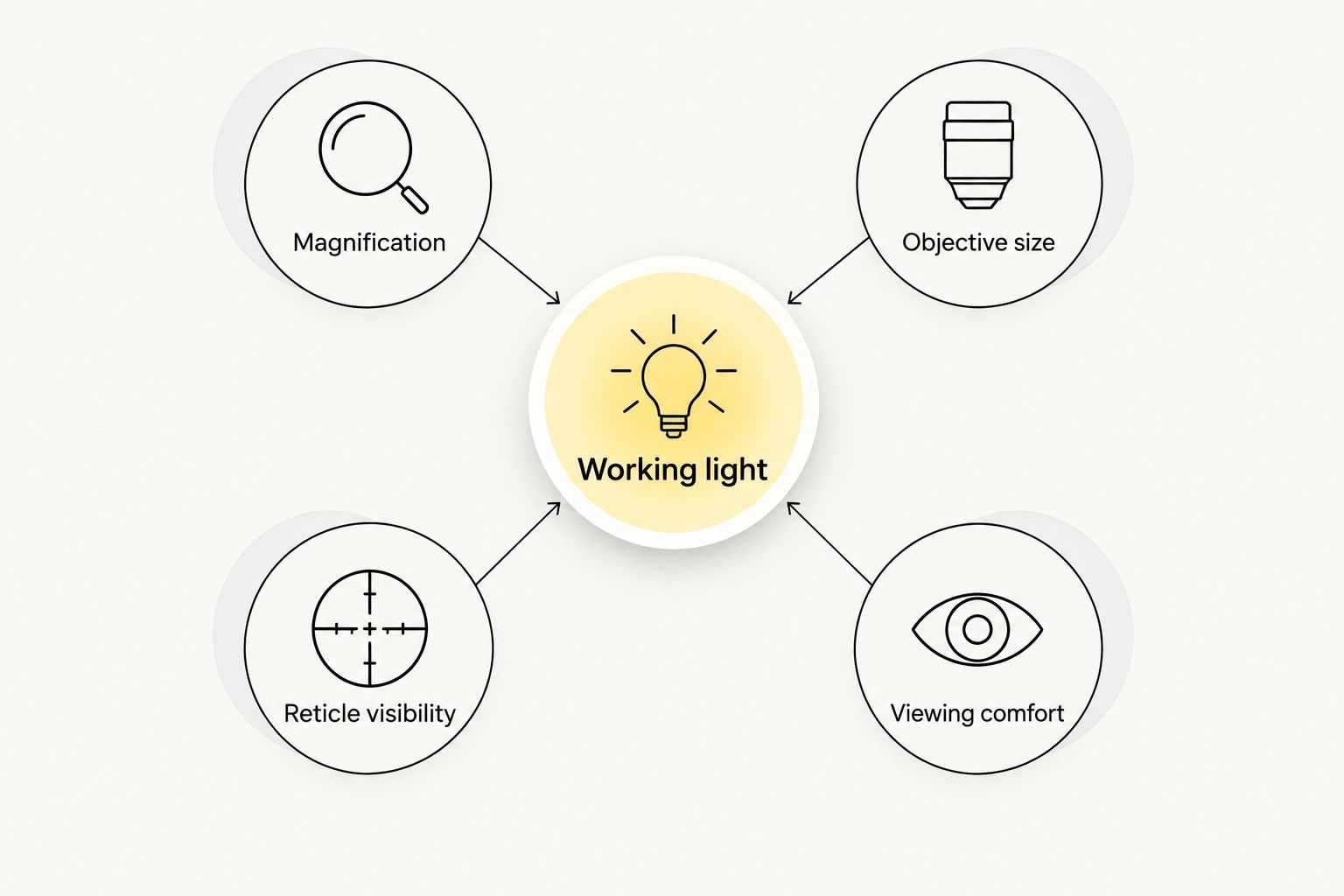
- Magnification: use comparable settings during an optical comparison.
- Objective size: treat diameter as one factor, not a verdict.
- Reticle visibility: check whether the aiming mark remains distinct.
- Viewing comfort: inspect edge shading and ease of eye alignment.
- Working light: assess conditions relevant to your duties.
Select a reticle and adjustment system you understand
Start by identifying what you need to see through the scope. A simple hunting reticle and a marked reticle serve different preferences. More markings are useful only when you understand their purpose and can still see the subject clearly.
First focal plane and second focal plane describe how the reticle behaves as magnification changes. In an FFP scope, reticle subtensions remain consistent across magnification. In an SFP scope, their stated angular values apply at the manufacturer’s specified magnification. Confirm that setting in the manual rather than assuming it.
Element Optics Helix is identified in the supplied product title as SFP with an EHR-1C MOA reticle. Nikko Stirling Diamond is identified with an illuminated #4 dot. These descriptions establish different reticle formats, not a universal winner.
Choose the reticle you can interpret reliably, not the one with the most markings. Illumination improves reticle visibility; it does not brighten the landscape or turn a conventional optic into night vision.
- Read the reticle diagram before buying.
- Confirm whether the scope uses FFP or SFP.
- Match the adjustment units to terminology you understand.
- Check the specified magnification for SFP subtensions.
- Examine the lowest useful illumination setting where applicable.
Check mounting fit before committing to an objective size
Use the scope and rifle manufacturers’ specifications to check compatibility. Tube diameter, ring dimensions, objective clearance and eye relief are distinct measurements. A 50 mm objective does not tell you the tube diameter or the ring height required.
The supplied Element Optics Helix and Nikko Stirling Diamond titles specify 30 mm tubes. That establishes the required ring diameter, but not compatibility with your rifle’s mounting interface. Obtain model-specific confirmation and use a competent gunsmith where fitting or clearance is uncertain.
Consider the complete rifle, not the optic in isolation. A scope that requires an awkward head position is a poor fit even when its optical specification looks suitable. Check comfortable alignment with an unloaded firearm under safe handling conditions, following professional guidance.
For a 2026 replacement, retain a written record of the approved mounting components. Do not assume that rings from an existing scope suit its replacement.
- Confirm the scope’s tube diameter.
- Confirm the rifle’s mounting interface.
- Check objective and control clearance.
- Check comfortable eye alignment and manufacturer-stated eye relief.
- Ask a competent gunsmith to resolve uncertain compatibility.
Separate digital night vision from conventional optical needs
Begin by deciding whether you need an electronic image at all. A conventional scope gives an optical view; digital day/night equipment presents a sensor-generated image on a display. Those are different systems with different operating requirements.
Hikmicro Alpex 4K LITE LRF A40EL is explicitly listed as a digital day/night scope with a 40 mm specification and a 3840×2160 sensor. Sensor resolution is not a guarantee of identification at a particular distance. Lighting, conditions and the complete system affect what you can distinguish.
A digital scope also introduces power management, menus and model-specific accessory requirements. Confirm the current manual’s requirements rather than assuming an illuminator, mount or other accessory is included. A rangefinder reading does not establish species identity, a safe background or permission to proceed.
Choose digital equipment for a defined, lawful night-time requirement—not because it has more electronics. For Ireland in 2026, confirm the rules applying to your intended species, activity and equipment with the relevant authorities before purchase or use.
- Confirm the legal basis for the intended activity.
- Read the model’s power and operating requirements.
- Check which accessories the exact package includes.
- Evaluate identification separately from detection.
- Keep a suitable handheld observation method available.
Compare options for professional gamekeepers
Use this table to match the optic format to the job. The specifications below come from the supplied product titles and descriptions; the limitations identify selection trade-offs, not measured defects. None of these entries establishes comparative durability or optical performance.
| Option | Best for | Relevant specification | Key limitation |
|---|---|---|---|
| Nikko Stirling Diamond | General hunting scope comparisons with a lower starting magnification | 2.5–10x50, 30 mm tube, illuminated #4 dot | Conventional optics do not provide electronic night vision |
| Steiner Ranger 4 | Comparing an illuminated hunting reticle in a similar magnification range | 2.5–10x50, 4A-I illuminated reticle | Matching magnification and objective figures do not establish better image quality |
| Element Optics Helix | Dedicated higher-magnification work and range comparisons | 6–24x50, SFP, 30 mm tube, EHR-1C MOA | Its 6x minimum is less flexible for duties requiring lower magnification |
| Hawke Vantage SF 3–12x44 Half Mil Dot | Comparing a 44 mm objective configuration with a marked reticle | 3–12x44, Half Mil Dot | The listed name alone does not establish optical performance or rifle compatibility |
| Hikmicro Alpex 4K LITE LRF A40EL | A defined, authorised digital day/night role | 40 mm, 3840×2160 sensor, integrated LRF | Requires power management and confirmation of legal and accessory requirements |
Wildhunter Gunroom rifle scope selection spans these different formats. Build a shortlist around one working requirement first; mixing conventional hunting optics, higher-magnification scopes and digital equipment without a clear brief makes comparison less useful.
The following product cards represent distinct choices rather than an overall ranking. Use their specifications to organise your enquiries, then confirm the exact configuration and compatibility.


Common mistakes professional gamekeepers make
Buying one scope for incompatible duties
A scope selected for higher-magnification range work does not automatically suit every estate rifle. Write separate briefs for genuinely different roles. Keep an existing suitable optic rather than replacing it merely to standardise product names.
Treating twilight visibility as night vision
A large objective and illuminated reticle do not create an electronic night image. Specify whether the problem is reticle visibility, optical detail in fading light or a lawful requirement for digital equipment. Each calls for a different assessment.
Ignoring fit when comparing specifications
Objective diameter and zoom range attract attention, but neither establishes comfortable eye alignment. Confirm mounting compatibility and viewing position before committing to a scope. Include the mounting system in the decision, not as an afterthought.
Confusing detection with identification
Seeing an animal-shaped image is not sufficient identification. Neither sensor resolution nor a rangefinder reading settles what the subject is or what lies behind it. Keep identification, permissions and safe handling separate from product feature claims.
Leaving equipment records until something fails
Retain the exact model, manual, mounting details and relevant battery information where applicable. Record damage or recurring problems when they occur. A clear equipment record makes repair enquiries and future replacement decisions more specific.
FAQ
What are the best rifle scopes for gamekeepers in 2026?
The best rifle scopes for gamekeepers match working light, usable magnification, reticle visibility and rifle fit. Compare conventional hunting scopes for daylight and twilight duties, and assess digital equipment separately for authorised night-time requirements.
Is a 50 mm objective enough for a gamekeeper’s rifle scope?
A 50 mm objective is not enough information to judge suitability. Magnification, optical quality, reticle visibility and comfortable eye alignment also affect the usable view.
Is 6–24x better than 2.5–10x for estate work?
Neither magnification range is better for every estate duty. A 2.5–10x scope offers a lower starting magnification, while a 6–24x scope suits a brief that specifically requires more magnification.
Does an illuminated reticle work like night vision?
No, an illuminated reticle lights the aiming mark rather than the landscape. Digital night vision uses a sensor and display, with power and accessory requirements that depend on the model.
Should a professional gamekeeper choose FFP or SFP?
Choose FFP or SFP according to how you need the reticle to behave when magnification changes. FFP subtensions remain consistent across magnification; SFP subtensions apply at the manufacturer’s specified setting.
Can existing scope rings be reused with a new optic?
Existing rings are suitable only if their dimensions, interface and clearance match the new optic and rifle. Confirm the complete combination with manufacturer specifications or a competent gunsmith.
Can Irish gamekeepers use digital night vision for every species?
Do not assume digital night vision is lawful for every species or activity in Ireland. Confirm the rules and any required authorisation with the relevant authorities before purchasing or using the equipment.
One last thing
An illuminated reticle improves visibility of the reticle, not visibility of the landscape. That distinction prevents a common purchasing error: trying to solve an identification problem with brighter illumination.
Before your final 2026 decision, ask Wildhunter Gunroom about the exact configuration you have shortlisted and confirm the unresolved specifications. Take your written brief with you. The useful question is not which scope has the most features, but which scope fixes the limitation you have identified.