

Rifle scopes ranked by magnification and price 2026
The average maximum magnification across the three rifle scopes compared here is 13.3x, ranging from 12x to 16x; minimum magnification ranges from 2x to 4x. This 2026 rifle scope magnification and price comparison ranks the stated zoom ranges, explains their practical trade-offs, and directs you to current product listings for the buying decision.
- Wildhunter Gunroom’s rifle scope magnification and price comparison puts usable zoom before headline magnification.
- Vortex Crossfire II 4–16x50 leads this selection on maximum magnification at 16x.
- Bauer HD 2–12x50 has the lowest starting magnification at 2x and the widest zoom ratio.
- Hawke Vantage SF 3–12x44 has the smallest stated objective diameter in this comparison.
Why this matters
Maximum magnification is a specification, not a quality score. A scope that reaches 16x does not automatically give you a clearer image, a better reticle or a more suitable fit than one that stops at 12x.
Wildhunter Gunroom’s rifle scope comparison is best for licensed Irish shooters comparing stated magnification ranges before choosing an optic. Read both ends of the range: the lower setting matters just as much as the upper setting when deciding whether a scope suits your intended use.
Rifle scope magnification benchmark for 2026
Magnification describes how much larger the viewed subject appears relative to an unmagnified view. Across this selected group, average maximum magnification is 13.3x, with individual maximum settings of 12x, 12x and 16x.
The table is ordered by maximum magnification, highest first. The two 12x models share their position; neither receives an optical-quality ranking from its specification alone.
| Maximum-magnification rank | Rifle scope | Minimum magnification | Maximum magnification | Objective diameter | Zoom ratio | Best for |
|---|---|---|---|---|---|---|
| Overall selected group | Three compared models | 3x average | 13.3x average | 48mm average | 4.7:1 average | Comparing the specification spread |
| Highest | Vortex Crossfire II 4–16x50 | 4x | 16x | 50mm | 4:1 | Buyers prioritising the highest maximum magnification here |
| Joint second | Bauer Rifle Scope HD 2–12x50 L7 | 2x | 12x | 50mm | 6:1 | Buyers prioritising a lower starting magnification |
| Joint second | Hawke Vantage SF 3–12x44 Half Mil Dot Reticle | 3x | 12x | 44mm | 4:1 | Buyers prioritising the smallest stated objective diameter |
Vortex Crossfire II leads on maximum magnification at 16x; Bauer HD and Hawke Vantage SF both stop at 12x. Bauer HD leads on zoom ratio at 6:1 and starts lowest at 2x, while Vortex Crossfire II starts highest at 4x.
Methodology: this 2026 comparison uses the magnification ranges and objective diameters stated in the three named product listing paths supplied for Wildhunter Gunroom; averages are arithmetic means, rounded where necessary. These specifications cannot establish optical clarity, mechanical reliability or performance in low light.
What the overall row actually means
The overall row describes this selection, not the Irish rifle scope market. Its 13.3x average maximum gives you a yardstick for these three models; it does not establish an ideal magnification for every shooter.
The same distinction applies to the 48mm average objective diameter. None of these models has a stated 48mm objective: that figure summarises a group containing one 44mm objective and two 50mm objectives.
Use the individual rows to choose; use the overall row to understand the spread. An average combines specifications, but it is not a substitute for a scope that matches your actual requirements.
How to use these benchmarks
- Prioritise the starting magnification when your requirement is a lower-powered view. Bauer HD starts at 2x, Hawke Vantage SF at 3x and Vortex Crossfire II at 4x. Those differences remain relevant even though two models share a 12x maximum.
- Prioritise the maximum only when you need the additional image enlargement. Vortex Crossfire II reaches 16x versus 12x for the other two. That is a magnification advantage, not proof of greater resolution.
- Separate zoom ratio from maximum magnification. Bauer HD has a 6:1 ratio despite its 12x ceiling; Vortex Crossfire II has a 4:1 ratio despite reaching 16x.
- Check the physical fit separately. Hawke Vantage SF has a 44mm objective, compared with 50mm on the other two. Objective diameter alone does not determine the required mount height or the complete scope’s dimensions.
For your 2026 shortlist, decide which of those differences solves a real requirement. Do not give every specification equal weight simply because it appears in a table.
The three scopes: advantages, limits and verdicts
Vortex Crossfire II 4–16x50
Best for: buyers whose priority is the highest maximum magnification in this selection. Vortex Crossfire II reaches 16x, giving it the highest upper setting among the compared models. Its stated objective diameter is 50mm.
The trade-off is its 4x starting magnification. If your priority is access to a lower setting, Bauer HD’s 2x minimum and Hawke Vantage SF’s 3x minimum deserve attention before the Vortex’s higher ceiling.
A 4–16x range has a 4:1 zoom ratio: the maximum is four times the minimum. That describes adjustment span, not how much usable detail the glass resolves or how comfortable the view feels to your eye.
Verdict: Hold until you confirm that the 16x ceiling matters more than a lower starting setting.
Bauer Rifle Scope HD 2–12x50 L7
Best for: buyers prioritising the lowest starting magnification and widest zoom ratio here. Bauer HD starts at 2x and reaches 12x. Its 6:1 zoom ratio is the widest in this selected group.
Its limitation is straightforward: it does not reach the Vortex Crossfire II’s 16x maximum. If that upper setting is a firm requirement, the Bauer’s broader ratio does not compensate for a lower ceiling.
Bauer HD and Vortex Crossfire II both state a 50mm objective diameter. That shared measurement does not establish equal light transmission, image quality, weight or mounting requirements; compare those separately rather than treating the matching diameter as equivalent performance.
Verdict: Hold until you confirm that the 2x starting setting matches your priority.
Hawke Vantage SF 3–12x44 Half Mil Dot Reticle
Best for: buyers prioritising a 3–12x range with the smallest stated objective diameter here. Hawke Vantage SF combines a 3x minimum, a 12x maximum and a 44mm objective. Its zoom ratio is 4:1.
The compromise is that it neither starts as low as Bauer HD nor reaches as high as Vortex Crossfire II. It occupies the middle position on starting magnification and shares the lower maximum setting.
The 44mm objective is a clear dimensional distinction. It does not, by itself, prove that the whole scope is lighter, that it will fit lower mounts, or that its image is less useful than either 50mm model.
Verdict: Hold until you confirm that the 3–12x range and objective dimensions suit your requirements.
How to read magnification without overvaluing it
A designation such as 3–12x44 contains different kinds of information. The 3–12x portion states the magnification range; the 44 states the objective lens diameter in millimetres.
Do not read the final number as another magnification setting. Likewise, do not confuse objective diameter with the scope’s tube diameter: they describe different parts of the optic and answer different compatibility questions.
Zoom ratio is calculated by dividing maximum magnification by minimum magnification. Bauer HD’s 12x maximum divided by its 2x minimum produces 6:1; either 3–12x or 4–16x produces 4:1.
A larger zoom ratio does not necessarily mean a higher maximum setting. This comparison illustrates that distinction directly: the 6:1 model stops at 12x, while one of the 4:1 models reaches 16x.
Higher magnification also enlarges visible movement in the view. More enlargement is therefore not an automatic improvement in viewing comfort, particularly when the scope is not held steadily.
Compare the buying decision, not just the zoom range
Use four separate checks when comparing Wildhunter Gunroom rifle scopes: Magnification range, Optical view, Reticle requirements and Physical fit. Each answers a different question, so a strong result in one category should not conceal a mismatch in another.
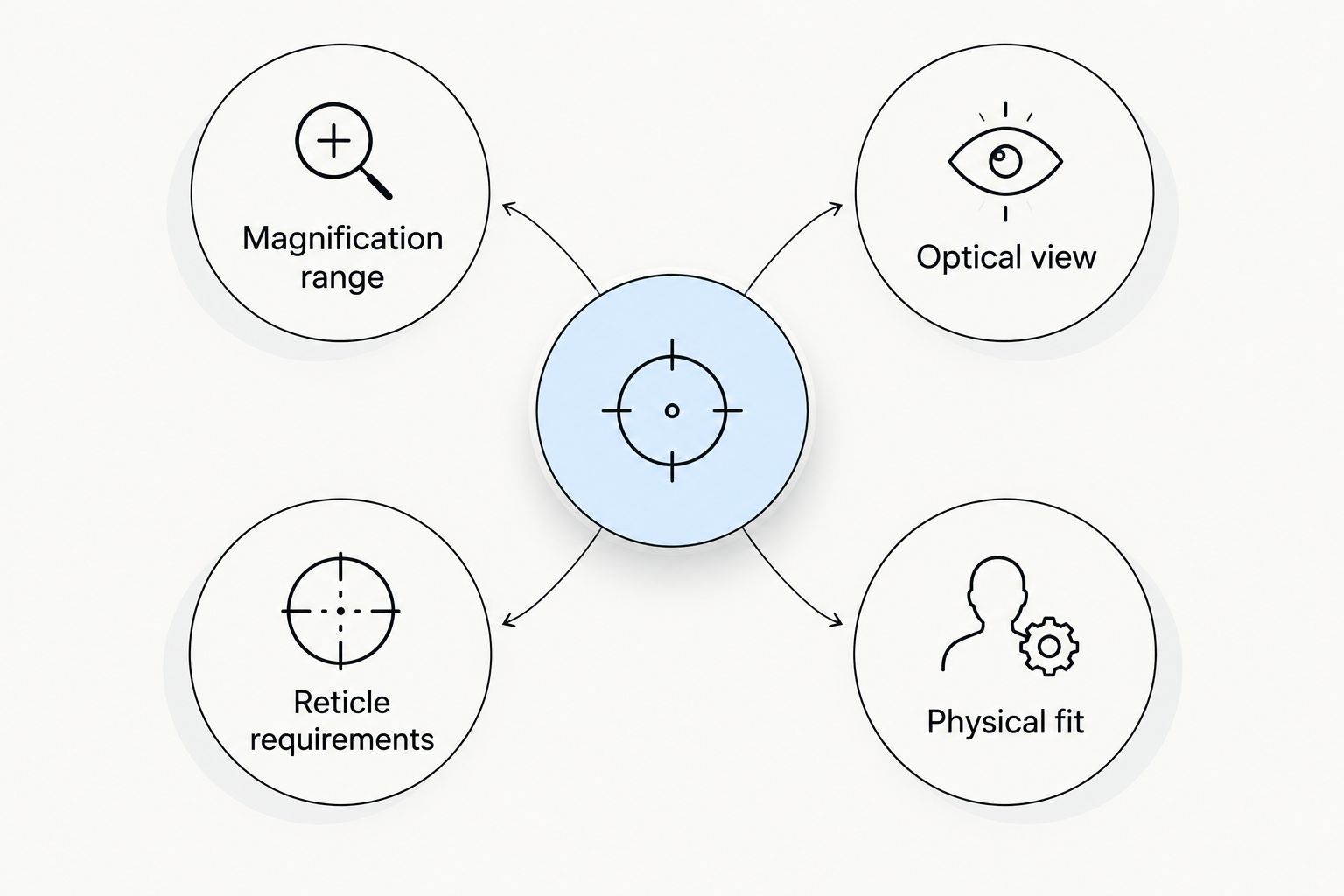
Magnification range
Compare minimum and maximum together. In this group, choosing 2–12x instead of 4–16x changes both ends of the range; it is not simply choosing less maximum magnification.
Write down which end matters more to you before comparing listings. That prevents a prominent upper figure from deciding the purchase without reference to your requirements.
Optical view
Assess image clarity, contrast and viewing comfort separately from the numbers in the table. Objective diameter and magnification do not provide a complete assessment of the image you see.
Where you can inspect an optic, compare views under similar conditions. An unequal comparison tells you as much about the conditions as it does about the scope.
Reticle requirements
Check the actual reticle specification and focal-plane arrangement for the model you are considering. Magnification range alone does not establish either feature.
Choose reticle visibility and presentation deliberately. A scope’s upper magnification setting should not distract you from a reticle that you find difficult to read.
Physical fit
Confirm tube diameter, overall dimensions and compatibility with your mounting arrangement using the relevant specifications. A 50mm objective measurement is not a complete fitting specification.
Avoid assuming that two scopes with matching magnification ranges will fit identically. Their external dimensions and mounting requirements remain separate checks.
Compare current listings consistently
For a 2026 buying comparison, assess the exact model and variant rather than the manufacturer name alone. Similar names can describe different magnification ranges, reticles or configurations.
Open the current listings together and compare what each listing describes. Keep scope specifications separate from any accessories you also need, so you do not mistake a different package for an equivalent comparison.
Do not use magnification as a shortcut for value. The 16x model leads one column; the 2x-starting model leads another. Your requirements determine which difference deserves priority.
FAQ
What is the average maximum magnification in this rifle scope comparison?
The average maximum magnification is 13.3x across the three selected scopes. Their individual maximum settings are 12x, 12x and 16x; this is a selected-group average, not an Irish market benchmark.
Which compared rifle scope has the highest magnification?
Vortex Crossfire II 4–16x50 has the highest maximum magnification at 16x. Bauer HD 2–12x50 and Hawke Vantage SF 3–12x44 both reach 12x.
Which compared rifle scope starts at the lowest magnification?
Bauer HD 2–12x50 starts lowest at 2x. Hawke Vantage SF starts at 3x, while Vortex Crossfire II starts at 4x.
Is a 4–16x scope better than a 2–12x scope?
A 4–16x scope provides a higher maximum, while a 2–12x scope provides a lower minimum. Neither range establishes better optical quality; choose the range that matches your viewing requirements.
What does 3–12x44 mean on a rifle scope?
3–12x44 means variable magnification from 3x to 12x and a 44mm objective lens diameter. The objective measurement is not the tube diameter.
Does a 50mm objective guarantee a better low-light image than a 44mm objective?
No, objective diameter alone does not establish low-light image quality. Magnification, optical transmission and other aspects of the optical design also affect the view.
How should I compare rifle scope listings in 2026?
Compare the exact model, magnification range, reticle specification and configuration in each current listing. Assess physical compatibility separately rather than assuming that similar scope names mean equivalent specifications.
One last thing
The widest zoom ratio in this 2026 comparison belongs to the scope with the lowest starting magnification, not the highest maximum. Bauer HD’s 2–12x range delivers 6:1, while Vortex Crossfire II’s 4–16x range delivers 4:1.
Before deciding, cover the maximum-magnification column and compare the minimum settings. That simple second look keeps the headline number from making the decision for you.