

Rifle Moderator Thread Adaptor: 2026 Fitting Guide
A rifle moderator thread adaptor lets Irish hunters and sport shooters fit one moderator across rifles with different muzzle threads, instead of buying a second moderator and adding a second entry to an FAC. Rifle makers cut different thread pitches even within the same calibre range, so an adaptor is often the cheaper fix when a new rifle or a new moderator doesn't match what you already own.
- A rifle moderator thread adaptor fits a moderator with a mismatched internal thread onto your rifle's muzzle without a new moderator purchase.
- Measure both threads with a gauge before ordering an adaptor — catalogue listings for the same model can vary between production runs.
- Steel step-down adaptors suit most calibre jumps in 2026; titanium cuts weight but costs more and is harder to source in Ireland.
- Baffle strike is the main risk with a badly matched adaptor — check clearance before the first shot, not after.
Why thread adaptors matter for Irish shooters
Most Irish FAC holders don't run one rifle for life. A stalker adding a .243 to a .308 FAC, or a fox controller picking up a rimfire alongside a centrefire, ends up with two or three muzzle threads and one moderator. Choosing a rifle moderator or silencer already covers matching a new moderator to a calibre — a thread adaptor solves the narrower problem of making an existing moderator fit a muzzle it wasn't cut for.
The constraint is mechanical, not financial: a moderator's internal thread has to seat square and tight on the muzzle, or baffle strike and point-of-impact shift follow. An adaptor is a bridge between two fixed specs, not a universal fix, and it only works when both ends are measured correctly.
Step-by-step: fitting a thread adaptor correctly
Measure your rifle's muzzle thread
Don't take the thread spec off the box your rifle came in years ago. Barrels get re-crowned, threads get re-cut after damage, and listings for the same model change between production runs.
- Use a thread pitch gauge, not a tape measure, to check thread count per inch or metric pitch
- Check both the outside diameter of the muzzle thread and the pitch together — the two have to match, not just one
- Note whether the thread is metric (M14x1, M15x1, M18x1) or imperial (1/2x20 UNF, 5/8x24 UNF)
- If the muzzle is unthreaded, this step ends the adaptor question — you need a gunsmith to cut a thread first
Measure your moderator's internal thread
The moderator's thread spec matters just as much as the rifle's, and it's the number most shooters skip because they assume the box label is accurate.
- Check the moderator's spec sheet or ask the retailer for the exact internal thread cut
- Confirm the moderator's bore diameter suits the calibre you're actually shooting, not just the calibre it was sold for
- If the moderator was bought secondhand, re-measure — a previous owner may have had it re-threaded
Match pitch and diameter before you order
An adaptor has to step from your muzzle's exact thread to your moderator's exact thread. Getting one of the two numbers wrong means a part that won't seat, not a part that seats loosely.
- Write down both thread specs side by side before contacting a supplier
- Ask whether the adaptor is a step-up or step-down — direction matters as much as size
- Confirm shoulder-to-shoulder fit, not just thread engagement, so the moderator sits square on the muzzle
- If you're not confident reading a thread gauge yourself, a gunsmith can confirm both specs in one visit
Pick the right adaptor and skip the guesswork
Buying loose parts and hoping they fit is the slow way. The faster path for most Irish shooters is buying a moderator already cut for their rifle's thread, which removes the adaptor question entirely.
- The Stalon X108 moderator and similar centrefire moderators are worth checking against your muzzle spec before you commit to an adaptor purchase
- If you already own a moderator you want to keep using, a dedicated adaptor is still cheaper than a second moderator
- Confirm the adaptor material suits your calibre's pressure — a mismatch here is a safety issue, not a fit issue
- Ask about baffle clearance specifically for your moderator's first baffle, since that's where strike happens
Fit and torque the adaptor correctly
A hand-tight adaptor is a loose adaptor after a dozen rounds. Fitting it correctly the first time avoids a re-visit to the range or the gunsmith.
- Clean both threads before assembly — grit in a thread is the most common cause of a cross-threaded fit
- Thread the adaptor onto the muzzle first, fully seated, before adding the moderator
- Use a moderator wrench where the design calls for one rather than gripping the can body directly
- Recheck for a square, flush seat with no visible gap between shoulders
Test-fire and recheck for baffle strike
The first few rounds after fitting any adaptor tell you whether the fit is right. Skipping this step is how shooters end up with a damaged baffle stack months later.
- Fire from a rest at a known target distance and check for point-of-impact shift versus your zero
- Inspect the muzzle end of the moderator for contact marks after 5-10 rounds
- Recheck adaptor tightness after the first range session, since new threads can settle slightly
- If accuracy drops or you hear a change in report, stop and recheck the fit before firing again
Maintain the adaptor over time
An adaptor left on a rifle for a season without attention corrodes at the thread interface, especially with Irish weather.
- Strip and clean the adaptor threads after wet-weather use, the same way you'd clean the bore
- Check torque again at the start of each season, not just after fitting
- Store the adaptor with a light coat of gun oil if it's off the rifle for extended periods
- Replace an adaptor showing thread wear rather than forcing another season out of it
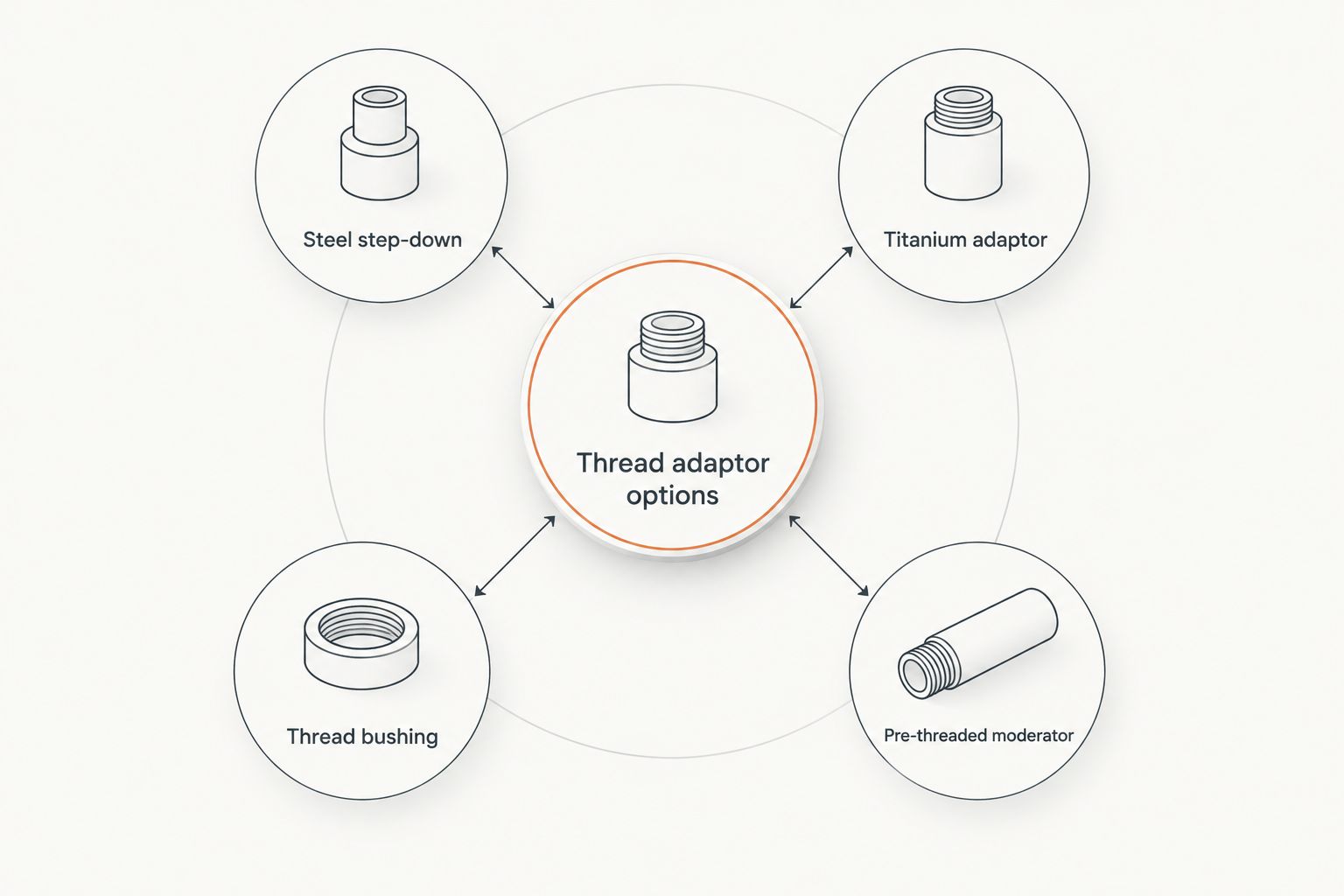
Thread adaptor options compared
| Option | Best for | Key limitation |
|---|---|---|
| Steel step-down adaptor | Moving a moderator from a larger to a smaller muzzle thread | Adds length and weight at the muzzle |
| Titanium adaptor | Shooters prioritising muzzle weight over cost | Costs more and is harder to source in Ireland |
| Thread bushing/sleeve | Matching odd or metric threads like M14x1 or M15x1 | Not compatible with every baffle stack design |
| Pre-threaded moderator, no adaptor | Shooters buying a first or replacement moderator | Means running two moderators across two calibres |
“If you can't measure your thread pitch with a gauge, don't guess it from the catalogue listing.”
Common mistakes shooters make with thread adaptors
- Guessing the thread pitch instead of measuring it. Catalogue specs for the same rifle model can differ between production years.
- Stacking an adaptor without checking baffle clearance. A step-down adaptor changes how far the bore sits inside the first baffle.
- Skipping the post-fitting torque check. New threads settle after the first range session, and a loose adaptor shifts point of impact.
- Buying the cheapest adaptor without confirming the steel grade. Pressure from centrefire calibres demands a material rated for it, not whatever's in stock.
- Not re-checking an adaptor fitted to a secondhand moderator. A previous owner may already have had the moderator re-threaded to a different spec.
FAQ
What is a rifle moderator thread adaptor?
A rifle moderator thread adaptor is a machined piece that bridges a mismatch between a rifle's muzzle thread and a moderator's internal thread, letting one moderator fit rifles it wasn't originally cut for.
Can I fit any moderator to any rifle with an adaptor?
No. The adaptor only bridges thread pitch and diameter — the moderator's bore diameter still has to suit the calibre being fired, or baffle strike and accuracy problems follow.
Does a thread adaptor affect sound reduction?
A correctly fitted adaptor with a square, flush seat has minimal effect on sound reduction. A loose or misaligned fit lets gas escape at the joint and reduces performance.
What thread pitches are common on Irish rifles in 2026?
Common muzzle threads on rifles sold in Ireland include M14x1, M15x1, M18x1 and imperial pitches like 1/2x20 UNF and 5/8x24 UNF, but the exact spec varies by make and model year.
Do I need a gunsmith to fit a thread adaptor?
Fitting itself is straightforward with a moderator wrench, but a gunsmith can confirm both thread specs accurately if you're unsure how to read a thread gauge.
Can a thread adaptor cause baffle strike?
Yes, if the adaptor changes how far the muzzle sits inside the first baffle. Test-firing and checking for contact marks after fitting is the way to catch this early.
How do I know if my moderator and rifle thread match?
Measure both with a thread pitch gauge rather than relying on spec sheets, since the same rifle model can carry different thread cuts across production runs.
Is it cheaper to buy an adaptor or a second moderator?
An adaptor is almost always cheaper than a second moderator, but if you're buying your first or replacement moderator anyway, a pre-threaded match removes the adaptor question entirely.
One last thing
The detail that catches most shooters out isn't the adaptor itself — it's assuming their rifle's thread spec hasn't changed since the day they bought it. A re-crown after barrel damage, a factory tolerance shift, or a secondhand moderator that's already been re-threaded can all move the numbers. Measure both ends every time, even on a rifle you've owned for years, before ordering an adaptor for 2026 use.